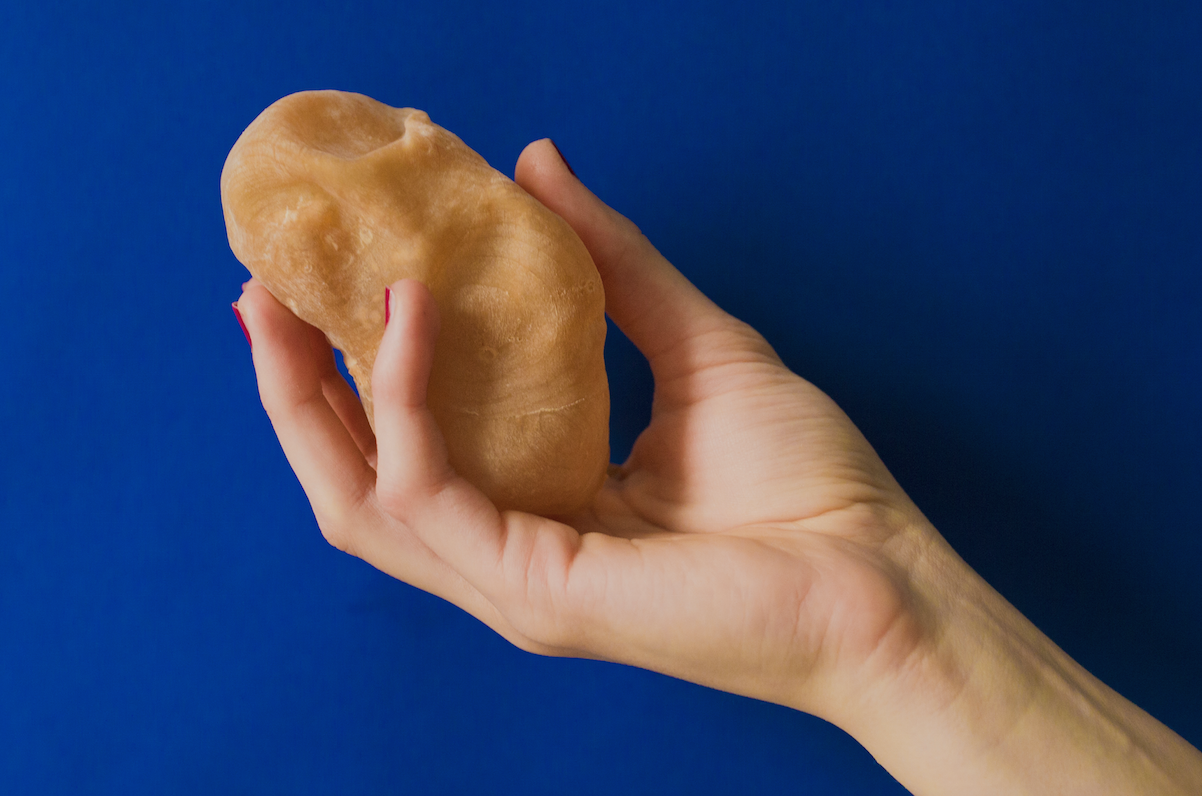
Mobile Lorm Glove – A Communication device for deaf-blind people.

The Mobile Lorm Glove is a communication and translation device for the deaf- blind. It translates the hand-touch alphabet Lorm, a common form of communication used by people with both hearing and vision impairment, into digital text and vice-versa. The prototype enables the deaf-blind user to compose messages via the pressure sensitive palm of the glove that are transmitted as a text message to the receiver’s handheld device. Vibrotactile feedback patterns allow the wearer to perceive incoming messages. It supports communication over distance, provides access to autonomous information and serves as an interpreter for people not familiar with Lorm.

Further info:
www.design-research-lab.org

Posted in accessible, deaf-blind | Tagged , , , , , , , , | Leave a comment

Touching new ways of commincation for 2012 and beyond….

Dear friends
Liebe Freunde
Caras amigos

A healthy, successful and happy 2012 to all of you (especially those we haven’t met this year)!
Euch allen (insbesondere denen, die wir in diesem Jahr leider nicht treffen konnten) sowie einen sicheren Rutsch in ein gesundes, erfolgreiches und von Humor geprägtes 2012!
Um próspero ano novo!

Some exciting projects have been going on. Feel free to check out one of them:
Spannende Projekte gab’s und wird’s auch weiterhin geben. Dies hier ist eines davon:
Vamos continuar a trabalhar de grandes projeitos. Por exemplo, este:

Take care!
Passt auf Euch auf!
Se cuiden!

Tom | DESIGNABILITIES.org

Posted in accessible, blind, body, care, deaf, design project, design research, design study, embodiment, Experience Disability, prototyping, research, social design, sustainability and social innovation, tactile communication, team | Leave a comment

Künstlerisch/Wissenschaftliche(r) Mitarbeiter/in gesucht…

Das Design Research Lab der Universität der Künste Berlin sucht ab Februar 2012 in Berlin eine/n

Künstlerisch/wissenschaftliche(n) Mitarbeiter/in im Projekt „Services für Demenz-Patienten“

Das übergreifende Ziel des Design Research Lab besteht darin, durch praktische und theoretische Beiträge im Bereich benutzerzentrierter Gestaltung das Feld der Design-Forschung weiterzuentwickeln und so einen Beitrag zur theoretischen und praktischem Wissensschöpfung im internationalen Designforschungsdiskurs zu leisten.

Tätigkeit: Die Tätigkeit umfasst User-Research mit Demenz-Patienten und deren Angehörigen sowie dem Pflegepersonal; Konzeption von Services für eine Tablet PC Anwendung; Interface- und Interaction-Design; Prototypenentwicklung (Papierprototypen, Flash-Dummies etc.); Durchführung von Benutzerstudien / User-Centered Design Methoden, Interface Evaluation; Abstimmung mit der technischen Implementierung sowie organisatorischen Aufgaben im Projektzusammenhang.

Voraussetzung: abgeschlossenes Designstudium (Produkt-, Grafik oder Interaktions-Design) Weiterhin:

 Praktische Erfahrung im Bereich Interfacedesign
 Gute Kenntnisse mit gängiger Design-Software (Adobe-CS)
 Erfahrung in der praktischen Umsetzung von Design Prototypen
 Grundlegende Programmierkenntnisse
 Gute Englischkenntnisse

Bewerbung
Bitte richten Sie Ihre Bewerbung mit Anschreiben, kurzer Begründung des Interesses am Projekt und Lebenslauf bitte an Gesche Joost (gesche.joost@udk-berlin.de). Die Vergütung erfolgt nach TVL als künstlerisch-wissenschaftlicher Mitarbeiter und ist zunächst auf ein Jahr begrenzt. Der Starttermin ist für Februar 2012 geplant, kann aber noch individuell verhandelt werden.

Wir freuen uns auf Ihre Bewerbung!

Kontaktinformation

Universität der Künste Berlin – Fakultät Gestaltung / IPP
Designforschung
Einsteinufer 43
10587 Berlin
www.design-research-lab.org

Posted in design research, jobs | Tagged , , , , | Leave a comment

Attitude Syndrome

Thanks to GUC Student* Caroline for sharing this campaign clip with us, which she and her group found yesterday!

* During his visiting professorship at the German University in Cairo, Tom Bieling has been conducting an intensive and productive workshop week (“Workshop against Normality”) with the 9th semester product design students. Some of the results will be also documented soon on DESIGNABILITIES.org

Posted in advertisement | Leave a comment

Sonic Experiments by Christine Sun Kim

Filmmaker and photographer Todd Selby profiles Christine Sun Kim‘s performance work. On Nowness we find the following description:

“Deaf from birth, Kim turned to using sound as a medium during an artist residency in Berlin in 2008, and has since developed a practice of lo-fi experimentation that aims to re-appropriate sound by translating it into movement and vision. “It’s a lot more interesting to explore a medium that I don’t have direct access to and yet has the most direct connection to society at large,” says the artist. “Social norms surrounding sound are so deeply ingrained that, in a sense, our identities cannot be complete without it.”

Christine Sun Kim, A Selby Film from the selby on Vimeo.

Posted in deaf, sound | Tagged , , , , , | Leave a comment

Impressions from “Falling Walls Lab”…

Posted in Uncategorized | Tagged , , , | Leave a comment

Tom Bieling wins 2nd Place at Falling Walls Lab 2011

100 ideas, 3 minutes, 1 day. At the Falling Walls Lab in Berlin, 100 inspiring people presented their breakthroughs. DESIGNABILITIES Initiator Tom Bieling was one them….and won the second place. Congrats!


[Chairmen of the falling walls lab jury, Ernst Th. Rietschel and Martin Sonnenschein together with the awardees: Tom Bieling, Jennifer Jordan, Shuo Zhang and Eileen Diskin (v.l.t.r.)]

The Falling Walls Lab took place on 8 November 2011, the day before the Falling Walls Conference in Berlin, and was organised by the Falling Walls Foundation with the support of AT Kearney.

Further info…


Posted in Uncategorized | Tagged , , , , | Leave a comment

Feature Discussion ‘Before and After Critical Design’

After our last lively feature discussion in april there will be another interesting one this friday. This time it will be in English again. The discussion is open for everyone to join. Looking forward to your contributions!

Feature Discussion ‘Before and After Critical Design’
Friday, September 2nd

10.00-18.00h (GMT +1)
on www.designresearchnetwork.org

The term ‘Critical Design’ appeared some twenty years ago in the design research community as a particular approach to human-machine interaction. Referring to a longer tradition of critical approaches in design and architecture, it was meant to re-establish alternative views on product and interface design, telling stories about human values and behaviour that were thought to be neglected in commercial product development.

Since then, as a method, strategy, or theoretical perspective, it has been widely interpreted, appropriated, adopted, enchanted and criticized by design researchers. In this feature discussion, the participants will debate the role of Critical Design for design and research practice.

The discussion is open to everyone. Please join!

Invited Discussants:

Simon Bowen, User Centred Healthcare Design, National Institute f. Health Research, UK

Carl DiSalvo, Georgia Institute of Technology, USA

Li Jönsson, Interactive Institute, Sweden

Tobie Kerridge, Goldsmith College, UK

Tau Ulv Lenskjold, The Danish Design School, Denmark

Ramia Mazé, Interactive Institute, Sweden

Regina Peldzus, Kingston University, UK

Alex Wilkie, Goldsmith College, UK

Program:
10.00-11.30 Critical of What? (Moderation: Ramia Mazé)
11.30-13.00 Critical Design outside the Gallery? (Moderation: Simon Bowen)
13.00-14.00 Break
14.00-15.30 Critical and Speculative Design as Scenario Building Approach in Science and Technology Contexts (Moderation: Regina Peldzus)
15.30-17.00 Is there a Post-Critical Design? (Moderation: Carl DiSalvo)
17.00-18.00 Conclusion and Open Questions

Organized by Katharina Bredies, Manager, DesignResearchNetwork

Posted in Uncategorized | Tagged , , , , , , , , , , , , , , , | Leave a comment

“Piercing a Tongue, in the Name of Mobility”

This project just caught our attention: A system, where the user wears a headset with sensors that pick up magnetic signals from a tongue ring. Moving the tongue to the mouth’s corners, moves the wheelchair forward or backward etc…

The full article in the New York Times you find here!

Posted in Uncategorized | Leave a comment

HangUp (Deafness-inspired Interaction at Design Research Lab Berlin)

“HangUp” is a tool that accounts certain human conditions or situations, where people can not use their hands while being on the phone. For example deaf people need both hands for sign language. But also non-deaf people are often confronted with comparable situations. For both there is a solution:

Hang up your phone to keep up your conversation!


The concept results from the Project “DESIGNABILITES” at the DESIGN RESERACH LAB of the University of the Arts in collaboration with T-Labs Berlin.

The project explores challenges and possibilites for disability-inspired interaction.

Main goals are to find ways for enhancing Human-Computer-Interaction (HCI) and Information-Communication-Technology (ICT) by transferring properties and principles from ‘disability’ context into general contexts of communication.

Therefore we investigate on alternative interaction techniques inspired e.g. by deaf communication or blind navigation.

project: Tom Bieling
direction & camera: Kai Hattermann

more info:

http://www.design-research-lab.org

http://www.designabilities.org

http://www.tombieling.com

Posted in accessible, co-design, deaf, design project, design research, Film, prototyping | Tagged , , , , , | Leave a comment

Mobile Alert Recognition (Deafness-inspired Interaction at Design Research Lab Berlin)

“Mobile Alert Recognition” is an application that identifies auditory alerts through signal recognition and informs the user about important events.
It results from the Project “Speechless” at the DESIGN RESERACH LAB of the University of the Arts in collaboration with T-Labs Berlin.


.

The project explores challenges and possibilites for disability-inspired interaction. Main goals are to find ways for enhancing Human-Computer-Interaction (HCI) and Information-Communication-Technology (ICT) by transferring properties and principles from ‘disability’ context into general contexts of communication. Therefore we investigate on alternative interaction techniques inspired e.g. by deaf communication or blind navigation.

project: Tom Bieling
direction & camera: Kai Hattermann

more info:

http://www.design-research-lab.org

http://www.designabilities.org

http://www.tombieling.com

Posted in accessible, alternative communication, care, co-design, deaf, design project, design research, Film, movie, universal design | Tagged , , , , , , , , , , , , , , , , | 2 Comments

Skintimacy

Thanks to Tangible Sound Lab for exploring interpersonal boundaries through musical interactions in their recent project ‘Skintimacy’, in which Alexander Müller, Jochen Fuchs and Konrad Röpke use skin-based interfaces for collaborative musical performances.

‘Skintimacy’ is intended to be both an evocative tool for interpersonal interaction and touch, as well as an alternative digital musical instrument. By integrating the human skin and touch into the musician-computer interface, a bodily-close haptic and emotional experience is proposed.

Skintimacy: Exploring Interpersonal Boundaries through Musical Interactions from Jochen Fuchs on Vimeo.

Alex on “Experiencing Intimacy”:

“The question of intimacy is brought to the foreground with the upcoming trend in HCI to use skin (and the precision of the sense of touch) as an interface. The collaborative setup is designed to give an auditively perceivable answer to the question: How can intimacy be experienced through sound when humans interact through mutual touch and perform with each other? Furthermore, since the instrument evokes interpersonal interaction, we want to employ Skintimacy as a playful tool that allows for the observation of intimate behaviour. We have discovered that personal and intimate borders are shifting significantly in a performative context where a computational (musical) process is linked to interpersonal touch.”

Posted in interaction, sound | Tagged , , , , , | Leave a comment

Conference Review: INCLUDE 2011

Last week (18-20 April) the Helen Hamlyn Centre at the London Royal College of Art conducted the sixth edition of INCLUDE, the biannual conference on Inclusive Design. This year’s theme: The Role of Inclusive Design in Making Social Innovation Happen.

The idea to complement the four conference strands (‘Public Life’, ‘Home & Health’, ‘Design Theory’, ‘Design Practice’) by a couple of hands-on workshops was a good one. Eventually one of the central conference topics was concerning the question of how Inclusive Design methods and tools could be a motor for social innovation. Unfortunately the workshops seemed to be too short after all, but for future conferences this could be nice format to dive deeper into a topic (maybe by half- or full-day workshops?).

Out of the three key note speakers, Stefan and I only saw Bill Morgridge, who first introduced his new place of work: the Smithsonian Cooper-Hewitt National Design Museum (NYC), then basically talked about the recent shifts in design practice: From personal, to social, to environmental perspectives. Ezio Manzini had to cancel his talk on short notice. Gerontologist Sarah Harper (Oxford University) gave her keynote at the Gala Dinner, which was already sold-out by the time we wanted to order tickets.

Some highlights: Alistair Macdonald’s big picture thinking; Stephen Wilcox’ as humorous as bright moderations; the 24h design challenge (five student groups had to solve a design task within 24 hours and did all well); and not least the very well organized event, plus the comfortable prevailing mood amongst the staff and participants.

Congratulations to Lieven De Couvreur and Jan Detand (University of West Flanders, Belgium) and to Richard Goossens (TU Delft), who won the best paper award for “The Role of Flow Experience in Co-Designing Open-Design Assistive Devices”. Also congrats to Miguel Neiva (Philosophy Institute University of Porto), who won the best poster award for his Colour Identification System for Colour-blind People. The award for the Best Inclusive Design Innovation went to Wendy Key-Bright and Joel Gethin Lewis, for their Co-creating tools for touch: “applying an inspire-create-play-appropriate methodology for the ideation of therapeutic technologies”.

Overall impression: Even though the focus of the conference is quite clear, we still found a broad range of topics, which is good. However sometimes the definitions and interpretations of certain topics seemed a little fuzzy (In one session we found ourselves confronted with the bizarre formula of “Social Innovation = (Social Needs / Resources) x Creativity”). At least one fundamental consensus seems to evolve (not only) amongst the design community, which is the notion that design maybe can not solve all the problems, but it definitely can moderate, steer and enrich the discourse.

The conference proceedings can be found here!

We look forward to INCLUDE 2013, while thinking about Alistair Macdonald’s suggestion to live and design life more like a good dinner, when in his closing remarks he quoted Robert L. Stevenson (1850-1894): “There is only one difference between a long life and a good dinner: that, in the dinner, the sweets come last”.

Posted in Conference, universal design | Tagged , , , , | Leave a comment

What distinguishes “Research through Design” from “Design”? (german text)

In one of our last feature discussions on www.designresearchnetwork.org, Prof. Wolfgang Jonas gave a plausible answer:

—please excuse: the text is in german —

Wie unterscheiden sich Design und RTD hinsichtlich ihrer Ergebnisse?
Wann ist es Design, wann ist es Forschung?

Eine schwierige Frage, auf die ich auch keine hundertprozentige Antwort habe. Ich rekapituliere noch einmal die Kategorien der Designforschung:

C1
research ABOUT design (Beobachter aussen, blickt nach innen): Hier werden disziplinäre wissenschaftliche Theorien benutzt, um den Gegenstand (Design) zu verstehen. Es gelten wissenschaftliche Standards, uneingeschränkt.

Research FOR design (Beobachter aussen, blickt nach aussen): Hier werden wissenschaftliche Theorien verwendet, um den Designprozess mit Wissen anzureichern. Ziel ist die Verbesserung des Prozesses im Hinblick auf Effizienz und Effektivität. Angewandte Forschung. Wissenschaftliche Standards fungieren als Garanten.

C2
Research THROUGH design (Beobachter innen, blickt nach aussen): Es geht um externe Ziele, d.h. die Verbesserung lebensweltlicher Situationen. Ergebnisse sind praktische Problemlösungen und / oder neues Wissen über die Verbesserung der Situationen. Dies kann auch Wissen über Phänomene sein, die von anderen Wissenschaften bereits mit ihren Mitteln behandelt wurden (als Beispiel aus Q&H fällt mir etwa ein: Der Begriff des Vertrauens im partizipatorischen Planungsprozess).

Research AS design (Beobachter innen, blickt nach innen): Der abduktive Prozess… hier kommt Wissenschaft vielleicht implizit / tacit vor, als kreativer Erfahrungsschatz…

Wir sprechen hier über Research THROUGH design als eine besondere Form der Designforschung. Unterschiede zwischen Design und RTD sind fliessend, unscharf, auch stark sozial bestimmt: – Bedeutung des Forschungsanteils: geht es um eine praktische Problemlösung oder um die Beantwortung einer Frage? – Methodik: Explizit, anerkannt und nachvollziehbar? – Zeitaspekt: unmittelbarer Problemdruck – Innovation – Exploration? – Implementierungsdruck: Je geringer desto mehr Forschungschance? – Forschungsintensität: wieviel neues Wissen ist erforderlich? – Systemcharakter: Je komplexer das Setting, desto mehr Forschungsanteil? – Transferierbarkeit: Je höher, desto eher Forschung? – …

Ich glaube, dass ich hier mit Bruce Archer übereinstimme, der das sehr viel rigoroser formuliert hat. Oder es klingt jedenfalls rigoroser.

Bruce Archer, The Nature of Research, Co-design, interdisciplinary journal of design, January 1995 pp 6-13

“To return to our intermediate question, it becomes clear that for academic recognition purposes a practitioner activity can rarely be recognised as in itself a research activity. One has to ask: Was the activity directed towards the acquisition of knowledge? Was it systematically conducted? Were the findings explicit? Was the record of the activity ‘transparent’, in the sense that a later investigator could uncover the same information, replicate the procedures adopted, rehearse the argument conducted, and come to the same (or sufficiently similar) conclusions? Were the data employed, and the outcome arrived at, validated in appropriate ways? Were the findings knowledge rather than information? Was the knowledge transmissible to others? Oniy when the answers to all these questions are in the affirmative can a practitioner activity be classed as research.” .

Posted in Definitions, design research | Tagged , , , | Leave a comment

Sign-to-Text (Deafness-inspired Interaction at Design Research Lab Berlin)

“Sign-to-Text” is an application for tracking fingeralphabet for SMS-use on Mobile Phones. It results from the Project “Speechless” at the DESIGN RESERACH LAB of the University of the Arts in collaboration with T-Labs Berlin.


.

The project explores challenges and possibilites for disability-inspired interaction. Main goals are to find ways for enhancing Human-Computer-Interaction (HCI) and Information-Communication-Technology (ICT) by transferring properties and principles from ‘disability’ context into general contexts of communication. Therefore we investigate on alternative interaction techniques inspired e.g. by deaf communication or blind navigation.

project: Tom Bieling
direction & camera: Kai Hattermann

http://www.design-research-lab.org
http://www.designabilities.org
http://www.tombieling.com

Posted in accessible, alternative communication, care, deaf, design research, disability studies, Film, interaction, movie, research, universal design, visual communication | Tagged , , , , , , , , , , , , , , , , , , , | Leave a comment

Im Werden begriffen – Designperspektiven für Berlin (ARCH+ 201/202)


[ARCH+ issue 201/202 on Berlin; Cover by Meiré und Meiré]

The german magazine for archicture “ARCH+” recently published this one:

“Im Werden begriffen – Designperspektiven für Berlin
Von Bieling, Tom

Berlin, Stadt der Kreativen. 2006 zur „UNESCO City of Design“ ernannt, ist die Designszene der Stadt Anziehungspunkt für Praktizierende und Interessierte – national wie international. Was aber ist das eigentlich, eine kreative Stadt? Welches Potenzial, welche Verpflichtungen lassen sich, nicht zuletzt auf politischer Ebene, für die Stadt ableiten? Welche Entwicklungschancen bieten sich Berlin im Design-Sektor? Und was ist, jenseits der rhetorischen Floskel, das Spezifische an Berlin als Design-Standort? [...]

Read the whole article here!

http://www.archplus.net/home/archiv/artikel/46,3633,1,0.html

It also contains three interwies with Prof. Reto Wettach, Cornelia Horsch and Torsten Posselt!


[Wichtige Faktoren für Innovationen; Grafik aus DGTF-Studie]

Posted in Uncategorized | Tagged , , , , , , , , , , | Leave a comment

Feature Discussion: “Wie schaffen wir Designwissenschaft” (DRNetwork, 12.04.2011)

The official announcement will be posted here, as well as via DRNetwork and dgtf, soon! 
So, this one’s only an advance notice:

Feature Discussion auf DRNetwork – ‚Wie schaffen wir Designwissenschaft?’ 12.04.2011

‚Wie schaffen wir Designwissenschaft?’ knüpft an die letzte feature discussion ‚Vier Positionen zur Designwissenschaft’ an, die am 27.01.2011 stattfand.  

‚Vier Positionen zur Designwissenschaft’ kreiste um Definition und Bedeutungen sowohl von Designwissenschaft (DW), als auch von Design selbst. Diskutiert wurden Beiträge, Absichten, Ausprägungen, Inhalte und Aufgaben von DW. All dies stand in unmittelbarem Zusammenhang mit der Frage nach möglichen Formen und Formaten von DW. Eine Reihe von Analogien wurden dabei verwendet: DW in Anlehnung an Medizinwissenschaft (Wolfgang Jonas, June Park), Theater-, Literatur- oder Kunstwissenschaft (Rainer Funke), Biologie (Stephen Rust). Letztlich führte die Diskussion weder zu einer Synthese der unterschiedlichen Positionen, noch schien diese explizit erwünscht zu sein. Verständlich, angesichts der frühen Phase in der sich Designwissenschaft und die Debatte darum befinden! Vielmehr verstand man sich darauf, den Diskurs vorerst weiter vertiefen zu müssen, was nun in der kommenden feature discussion geschen soll. Bauen wir also auf den bisherigen Diskurs auf und fragen ‚Wie schaffen wir Designwissenschaft?’! In dieser feature discussion konzentrieren wir uns zu diesem Zwecke auf eine Reihe von spezifischen Fragen, die sich aus der letzten Diskussionsrunde ergeben haben.

Ziel ist es, einen leichten Zugang zum Diskurs über die Grundlagen und die Natur von Designwissenschaft im deutschsprachigen Raum zu geben. Die Online-Diskussion baut auf der Publikation auf und beabsichtigt, diese Debatte fortzusetzen. Drei Autoren werden zusammen mit einem geladenen Gast dazu beitragen. Die Diskussion ist außerdem offen für alle interessierten Teilnehmer.”

Diskutanten:
Dipl.-Des. Tom Bieling, UdK Berlin
Dipl.-Des. Katharina Bredies, UdK Berlin
Dipl.-Psych. Stephen Rust
Prof. Dr. Sabine Foraita, HAWK Hildesheim
Dr. Gavin Melles, Swinburne University of Technology
Prof. Dr. Susann Vihma, Aalto University

Moderatoren:
Dr. Rosan Chow, UdK Berlin
Prof. Dr. Leif Ostman, Novia University of Applied Sciences
Prof. Dr. June H. Park, Kiel

Program 12.04.2011

10:00 Begin

10:00-11:30 Teil 1: Wie ließe sich DW etablieren, trotz oder gerade wegen ihrer unterschiedlichen Positionen in Bezug auf Ziel, Form(at) und Gegenstand?

11:30-13:00 Teil 2: Was sind die notwendigen Schritte, damit Designwissenschaft eine Zukunft hat?

13:00-14:00 Mittagspause

14:00-15:30 Teil 3: Wie müsste DW organisiert und wer muss hierzu mit einbezogen werden?

15:30-16:30 Kaffee Pause

16:30-17:00 Nachbereitung

Organisatoren: Dr. Rosan Chow, DGTF Themengruppe ‚Grundlagen der Designwissenschaft’ und Dipl.-Des. Tom Bieling, DRNetwork.

Grundlagen der Designwissenschaft ist eine Themengruppe innerhalb der DGTF mit dem Ziel, zur Etablierung der Designwissenschaft im deutschsprachigen Raum beizutragen (www.dgtf.de)

DRNetwork ist eine Online-Plattform für Designstudenten, die 2007 gegründet wurde. Ihr Ziel ist es, junge Designforschende dazu zu ermutigen, aktiv zur Entwicklung der Designforschung beizutragen.

Mach mit bei der Diskussion auf www.designresearchnetwork.org !

Online-Zugriff auf die Publikation‘Positionen der Designwissenschaft’ auf

www.uni-kassel.de/upress/publi/abstract.php?978-3-89958-876-7

Posted in design research, designwissenschaft | Tagged , , , , , , , , , , , , , , , , , , | Leave a comment

Open University: Mit den Händen sprechen

Die Europa-Universität Viadrina Frankfurt (Oder) führt das Projekt “Open University: Mit den Händen sprechen” durch. Gehörlose und hörende Referenten präsentieren von April bis Juni 2011 Vorträge/Filme/Performances/Diskussionen rund ums Thema Gebärdensprache und Gehörlosenkultur. Ein Projekt zum Abbau von Barrieren zwischen Hörenden und Gehörlosen und zur Förderung von Verständigung und gegenseitiger Akzeptanz. Hier das dazugehörige OpenUniversityProgramm als pdf.

Posted in deaf | Leave a comment

Teilnahmeaufruf: 5. Kolloquium ‘Design Promoviert’

Zum Jubiläum mal wieder in Berlin: Wie schon beim allerersten mal, so werden wir auch das 5. Kolloquium »Design promoviert« wieder in Berlin durchführen. Diesmal an der Universität der Künste, der neuen Heimat des Design Research Lab.

Am 4. Juni 2011 veranstaltet die Themengruppe »DESIGN promoviert« der Deutschen Gesellschaft für Designtheorie und -forschung (DGTF) in Zusammenarbeit mit dem Design Research Network und der UdK Berlin das fünfte Kolloquium »DESIGN promoviert«.

Das Kolloquium bietet Promovierenden im Design eine Gelegenheit, ihr Forschungsthema unter Gleichgesinnten zur Diskussion zu stellen. Erfahrene Designforscher werden eingeladen, uns mit hilfreichen Kommentaren zur Seite zu stehen. Vorträge zu erfolgreich abgeschlossenen Promotionen im Designbereich sollen die Veranstaltung abrunden.

Termine
15. April 2011 Einsendeschluss für alle Beiträge
28. April 2011 Benachrichtigung der Teilnehmer
27. Mai 2011 Anmeldeschluss
04. Juni 2011 5. Kolloquium Design Promoviert
(ca. 10:00 – 16:00 Uhr)

Veranstaltungsort
Design Research Lab, Universität der Künste
Fakultät Gestaltung / IPP
Einsteinufer 43, 10587 Berlin

Kosten
Damit wir die Kosten für Essen und Getränke vor Ort decken können, erheben wir einen Unkostenbeitrag von 15€ pro Teilnehmer. Die Anmeldung ist erst mit Eingang des Unkostenbeitrags abgeschlossen.

Teilnahme und Anmeldung
Das Kolloquium richtet sich insbesondere an alle Designpromovierenden und solche, die es werden wollen. Interessierte, die gern vortragen möchten, können ihre Kurzdarstellung von 500 Wörtern (plus Literaturverweise) bis zum 15. April 2011 auf http://www.design-promoviert.de/kolloquium/hochladen. Dort ist auch die Teilnahmeanmeldung möglich. Auch internationale Designpromovierende sind herzlich eingeladen zu partizipieren.

In der Kurzdarstellung sollen die folgenden Fragen beantwortet werden:
• Was ist, ganz allgemein, der aktuelle Stand der Forschungsarbeit?
• Was ist das Feld, in dem geforscht wird oder werden soll?
• Was ist das Forschungsproblem (nicht nur das Designproblem), das Anlass zur Forschung gibt?
• Wie lautet die Forschungsfrage (nicht nur die Designfrage)?
• Welche Untersuchungsmethoden werden/wurden verwendet bzw. sollen benutzt werden, um diese Frage zu beantworten (in Form von Design- und Beobachtungspraktiken)?
• Wie sind die forscherische und gestalterische Praxis verbunden, welchen Einfluss haben sie aufeinander?
• Wo gibt’s noch Probleme/Unsicherheiten bzgl. derer man sich Feedback im Kolloquium erhofft?

Jeder Vortragende hat 15 Minuten zur Präsentation und 15 Minuten zur Diskussion des Beitrags. Die konstruktive Diskussion des Themas steht im Vordergrund. Wir planen außerdem eine freiwillige Veröffentlichung der überarbeiteten Beiträge in Form von Kurzpapieren (max. 1500 Wörter), in denen die Rückmeldungen und Kommentare aus dem Kolloquium integriert sind.

Übergeordnete Vorträge
Zusätzlich können Vorschläge für übergeordnete Vorträge über Designpromotion in Deutschland eingereicht werden. Diese könnten beispielsweise Methoden, Prozessen und Strategien zum erfolgreichen promovieren im Design beschreiben oder Erfahrungsberichte über gute bzw. schlechte Rahmenbedingungen an Hochschulen sowie institutionelle Voraussetzungen für eine Promotion vorstellen.
Beiträge dieser Kategorie sollten bis zu 2000 Worte umfassen, die vor der Veranstaltung eingereicht und nach dem Kolloquium auf www.design-promoviert.de und www.designresearchnetwork.org dauerhaft veröffentlicht werden.
Folgende Fragen können darin z.B. beantwortet werden:
Welche Probleme gibt es mit einer Promotion im Design, und welche konkreten Möglichkeiten und Ansätze, um sie zu lösen?
Wie sind die formellen Anforderungen, und wie kann man sie am besten erfüllen?
Welche Modelle und Verfahren haben sich bewährt? Welche sind eher hinderlich?

Peer Review
Wir wollen nicht nur die Diskussionskultur, sondern auch das kritische Lesen unter Designforschern üben. Deswegen werden alle Beiträge einem Review-Verfahren – ebenfalls unter Design-Doktoranden – unterzogen. Das Review-Ergebnis dient hier zu besserer Vorbereitung auf die Präsentation und nicht als Ausschlusskriterium.

Für den Review sind u. a. folgende inhaltliche Aspekte ausschlaggebend:
Das vorgestellte Projekt sollte den Anspruch und den Umfang eines Promotionsthemas haben. Das heißt, es sollte einerseits groß genug sein, um eine mehrjährige Forschungsarbeit zu rechtfertigen. Es sollte andererseits neues grundsätzliches Wissen auf seinem Gebiet erarbeiten. Kürzere Entwurfsprojekte sollten deswegen in den Kontext einer entsprechend größeren Forschungsfrage gestellt werden.
Das Thema sollte ein Designforschungsthema sein, das heißt, für das designerische Handeln relevant sein. Es sollte sich also nicht nur um eine rein praktische Designarbeit handeln, sondern deutlich eine Forschungsfrage behandeln.

Wir sind Freunde von Forschung-durch-Design; der Forschungsanteil im Design soll jedoch deutlich werden. Entsprechend sollte ein Beitrag Antworten und Hinweise auf die Problemstellung, die Forschungsfrage, die verwendeten Methoden und Schlussfolgerungen geben können.

Aktuelle Infos gibt es dann über design-promivert und übers Design Research Network!

Posted in Conference, design research | Tagged , , , , , , , , | Leave a comment

Call My Attention (Deafness-inspired Interaction at Design Research Lab Berlin)

“Call My Attention” is an application for immediate Line-of-Sight Signaling on Mobile Phones. The application proposes a mobile device function to be used like a remote control, for achieving immediate attention. It results from the Project “Speechless” at the DESIGN RESERACH LAB of the University of the Arts in collaboration with T-Labs Berlin.

.

The project explores challenges and possibilites for disability-inspired interaction. Main goals are to find ways for enhancing Human-Computer-Interaction (HCI) and Information-Communication-Technology (ICT) by transferring properties and principles from ‘disability’ context into general contexts of communication. Therefore we investigate on alternative interaction techniques inspired e.g. by deaf communication or blind navigation.

http://www.design-research-lab.org
http://www.designabilities.org
http://www.tombieling.com

Posted in accessible, alternative communication, augmentative communication, care, co-design, deaf, design project, design research, disability studies, Film, interaction, movie, research, universal design, visual communication | Tagged , , , , , , , , , , , , , , , , , | Leave a comment

How A Blind Man Plays Video Games

Our fellow Matthias Loewe, just pointed our attention towards this mechanical engineering student and Gamer Terry Garret, who can play a perfect run in Abe’s Exoddus. Which is pretty awesome, considering Garrett is blind!
A report and interview can be read here:
There is also a video, demonstrating Terry’s skillz:


Posted in blind, game | Leave a comment

Geek love by Katherine Dunn

Susanna Hertrich recomended this one to us, since it seems to fit perfectly in our topic.
She says: “Slightely disturbing novel of a circus family of “freaks” that questions our understanding of normality. Expect weird sexual festishes, strange cults, crazy tyrants, limb amputations and murder. Very enteraining in one way and very sick in another. Good read”.

Thanks, Susann! It’s on our wish list now!

Posted in Uncategorized | Leave a comment

Anthropomorphe – Different views on the human body

“Man is the measure of all things: of things which are, that they are, and of things which are not, that they are not.” (Quote from the anthropomorphe blog) 

Anthropomorphe features an extensive collection of  stunning imagery that challenges our notions of the human body, its identities and surrounding, and thereby proposes a reflection on individual and collective human body identity.

Thanks  Susanna, for your designerly note!

Posted in blog, body | Leave a comment

TRANSNATURAL (Amsterdam, march/april 2011)


[transnatural; exhibition/symposium, amsterdam 2011; campaign: Lucy McRae]

Technology was the means by which mankind seperated itself from nature, and escaped its limitations. In the 21st century we move beyond the animosity between nature and technology. In a lot of areas we see new fruitful collaborations and new kinds of unity: in our dealings with the environment and with energy, but also in arts, architecture, fashion and games.

At the transnatural Festival, Media-artists, speculative designers, avant-garde businesses and bleeding edge researchers working between life and technology will feed and contextualize each other. Together they develop images, experiences and intuitions for the TransNatural culture and present attempts from art, design and science to fuse technology with nature. 

via multiplexart

Posted in Conference, design project, design research, design study, event, exhibition, fashion, interaction, performance, playful interaction | Leave a comment

Body Architecture by Lucy & Bart

Another perspective can of course be found in the “absurd” human enhancement works of LucyandBart (Lucy McRae and Bart Hess) that is often described as an instinctual stalking of fashion, architecture, performance and the body.

Both share a fascination with genetic manipulation and beauty expression, creating future human shapes, blindly discovering low – tech prosthetic ways for human enhancement.

As a body Architects they invent and build structures on the skin that re-shape the human silhouette. Their provocative, often grotesquely beautiful imagery suggest a new breed; a future human archetype existing in an alternate world. Visualized in scenarios which let the human body perform as an intimate interface with the material world.

Check out Lucy’s and Bart’s Websites:

http://www.lucymcrae.net/

http://www.barthess.nl/

Posted in art, body modification, posthumanism | Tagged , , | Leave a comment

Human Enhancement – The Role of Art and Design

Already mentioned before, but in context of certain art and design positions in terms of human enhancement technologies we would like to draw attention again to some of the RCA (Royal College of Art, London) projects in this field:

The Methods Network was an AHRC-funded, multi-disciplinary partnership which ran from 1 April 2005 to 31 March 2008 providing a national forum for the exchange and dissemination of expertise in the use of Information and Communication Technologies (ICT) for arts and humanities research.

The aims of the Methods Network were to promote, support and develop the use of advanced ICT methods in arts and humanities research and to support the cross-disciplinary network of practitioners from institutions around the UK; to develop a programme of activities and publications on advanced ICT tools and methods and to ensure the broadest participation of the community by means of an open call for proposals for Methods Network activities.

In collaboration with King’s College London, Sheffield Humanities Research Institute, Lancaster and Royal Holloway University, Professor Sandra Kemp was awarded funding to support a new initiative to promote and disseminate the use of ICT in UK Arts and Humanities research.

As part of the RCA’s involvement in the AHRC ICT Methods Network, Professor Sandra Kemp, Director of Research at the Royal College of Art co-hosted, with Professor Anthony Dunne from the Department of Design Interactions, a workshop entitled Human Enhancement Technologies: The Role of Art and Design (new tools and methods) at the Goethe-Institut in 2008.

Posted in art, bioethic, body modification, design project, design research, design study, Enhancement, philosophie, posthumanism, Transhumanity | Leave a comment

German Books on enhancement, bioethics, body aesthetics and transhumanity.

In context of our latest book recommendation we would also like to mention a couple of german publications around the enhancement debate.

First of all the nicely compiled “No body is perfect” (Editors: Johann S. Ach, Arnd Pollmann), which compiles 17 positions on bodytuning from various disciplines (authors e.g.: Bettina Schöne-Seifert, Kurt Bayertz, Matthias Kettner, Kurt W. Schmidt, Julia Schoch or Ludwig Siep). From philosophical, cultural-scientific, medical-ethic and pschological perspectives, this book discusses the borders of transhuman expansions.


[no body is perfect: Baumaßnahmen am menschlichen Körper - Bioethische und ästhetische Aufrisse, Transcript 2006]

Bettina Schöne-Seifert and Davinia Talbot edited the following two books for the Mentis Verlag:

“Enhancement: Die ethische Debatte” (including articles by Jürgen Habermas, Peter Kramer, Eric T. Juengst, Dan W. Brock, Carl Elliott, David DeGrazia, Arthur Caplan, Francis Fukuyama). And ”Neuro-Enhancement: Ethik vor neuen Herausforderungen”, which was co-edited by Johann S. Ach and Uwe Opolka and opens up a transdisciplinary discourse on ethical and social aspects of neuro-enhancement from various disciplines, such as philosophy, neuro-, medical-, law- and policital sciences.

From a life-science perspective, Eve-Marie Engels and Elisabeth Hildt enrich the discourse with their edited book “Der implantierte Mensch: Therapie und Enhancement im Gehirn (Lebenswissenschaften im Dialog)”, published by Verlag Karl Alber.

The book’s positions reach from anthroplogical to ethical and metatheoretical considerations amongst the fields of neurology, cognitive neuro-sciences, biophysics as well as philoshophical anthropology, philosophy of science or bioehtics. Altogether it includes questions concerning the relevance of categories like nature, technology or artificiality for the judgement of therapeutical approaches.


This recommendation list for german books shall be completed by two prior publications of philosopher Hans Jonas, both published by Suhrkamp: “Das Prinzip Verantwortung: Versuch einer Ethik für die technologische Zivilisation” (1979), and ”Technik, Medizin und Ethik: Zur Praxis des Prinzips Verantwortung” (1985), in which Jonas tries to implement the “Prinzip Verantwortung” into paradigmatic cases in the fields of biological research and medical practice. 


[Hans Jonas....Suhrkamp 1979/1985]

Posted in bioethic, body modification, Enhancement, implants, Literature, posthumanism, Transhumanity | Leave a comment

Book: Human Enhancement

In a recent publication the editors Julian Savulescu and Nick Bostrom compile several positions in the enhancement debate, basically gathering around the question, to what extent we should use technology to try to make “better human beings”, which undoubtfuly guides towards profound ethical questions.

Excerpt of the publishers’s description:

“Because of the remarkable advances in biomedical science, we must now find an answer to this question. Human enhancement aims to increase human capacities above normal levels. Many forms of human enhancement are already in use. Many students and academics take cognition enhancing drugs to get a competitive edge. Some top athletes boost their performance with legal and illegal substances. Many an office worker begins each day with a dose of caffeine. This is only the beginning. As science and technology advance further, it will become increasingly possible to enhance basic human capacities to increase or modulate cognition, mood, personality, and physical performance, and to control the biological processes underlying normal aging. Some have suggested that such advances would take us beyond the bounds of human nature.”


[Julian Savulescu, Nick Bostrom: Human Enhancement; 432 pages; Oxford University Press; 2010; ISBN-13: 978-0199594962]

“[...] They have generated intense public debate and have become a central topic of discussion within practical ethics. Should we side with bioconservatives, and forgo the use of any biomedical interventions aimed at enhancing human capacities? Should we side with transhumanists and embrace the new opportunities? Or should we perhaps plot some middle course? Human Enhancement presents the latest moves in this crucial debate: original contributions from many of the world’s leading ethicists and moral thinkers, representing a wide range of perspectives, advocates and sceptics, enthusiasts and moderates. These are the arguments that will determine how humanity develops in the near future.”

Authors:

Julian Savulescu is Uehiro Chair in Practical Ethics, Director of the Oxford Uehiro Centre for Practical Ethics, and Director of the Program on Ethics and the New Biosciences in the 21st Century School, University of Oxford

Nick Bostrom is Director of the Future of Humanity Institute at the University of Oxford. He previously taught at Yale University in the Department of Philosophy and in the Yale Institute for Social and Policy Studies.

Posted in Enhancement, Literature, posthumanism, Transhumanity | Leave a comment

Mixed Feelings (Documentary)

Thanks to our new team member Ulli, for pointing our attention to this intersting Documentary on the evolving convergence of technology and the humany body, especialy in “health” context:

http://www.pbs.org/kcet/wiredscience/video/embed/286

Posted in augmentative communication, blind, Film, implants, research, Transhumanity | Leave a comment

Design Research Lab – Alles NEU!

On the occasion of Gesche Joost‘s inaugural lecture, the Design Research Lab recently celebrated a “houswarming” of its new office at the University of the Arts.

In the course of the establishment of the endowed professorship, the research team transferred to the faculty of design at the University of the Arts Berlin. In cooperation with Deutsche Telekom Laboratories and TU Berlin, a new area of focus emerges for the University of the Arts Berlin, where the potential of research and development through and with design is explored.

The „Design Research Lab” group started in 2005 as a part of the Deutsche Telekom Laboratories and Technical University Berlin. Currently, a team of 9 scientific researchers is working on interdisciplinary design research projects. From the start, the main goal was to mediate the gap between technological innovations and real needs of people in their everyday living environment. Diverse human needs and requirements are addressed: of the elderly and teenagers, families and singles, people with different abilities and disabilities.

Main questions are:

How would we like to communicate and interact in the future?
What kind of design methods serve us in research and development?
How can people be integrated into research and development as experts of their everyday life?
Which forms of technological development and innovations can be utilized to improve social, environmental and economic sustainability?

The University of the Arts Berlin is becoming part of an international development, in which design is positioned as a major research field.
Within the framework of PhD-projects and interdisciplinary research approaches, several different contributions to the international scientific and design discourse are in development: New ways of tactile interaction with devices (“embodied interaction”), and textiles (“interwoven technology”), gender-specific requirements of communication technologies (“gender-inspired technologies”), concepts of sustainability in local neighborhoods (“networked neighbourhoods”) and alternative ways of communication inspired by (“sign language”) of deaf people.

Check out the new website:

http://www.design-research-lab.org/

Posted in design research | Tagged , , , , , , | Leave a comment

2nd Feature Discussion on ‘Designwissenschaft’ (DRNetwork, 12.april 2011)

After the last feature discussion in january, there is going to be a follow-up in april.
Under the working title ‘Wie schaffen wir Designwissenschaft?’, a group of invited participants will discuss with you several positions and challenges for designwissenschaft. Please mark the date on your calendar and feel free to join the discussion on Tuesday 12.04.2011. 

Further information will be posted soon via Design Research Network!
 Check out the documented feature discussion from january here:

part 1
part 2
part 3

Posted in design research | Leave a comment

5. Kolloquium ‘Design Promoviert’ in Berlin (Juni 2011)

Zum Jubiläum mal wieder in Berlin: Wie schon beim allerersten mal, so werden wir auch das 5. Kolloquium »Design promoviert« wieder in Berlin durchführen. Aller Voraussicht nach wird es am  4. Juni 2011 stattfinden. Dieses Mal an der Universität der Künste, der neuen Heimat des Design Research Lab. Aktuelle Infos gibt es dann über design-promivert und übers Design Research Network!

Posted in Conference, design research | Tagged , , , | Leave a comment

Abilities speak louder…


[VSA Arts of Colorado : Andrew Zareck | Art Direction and Design]

The Access Gallery + Studio at VSA Arts of Colorado conducted the “Special Needs Poster Project” GIVING VOICE. In this collaborative project, young people with disabilities were paired with a professional graphic designer. The only parameters were the vision of the young people and the talents of the designers. The posters presented are the end result of a joint project of VSA arts Colorado, Colorado Cross Disability Coalition and AIGA Colorado.

via: http://www.andrewzareck.com/print/vsa-arts-of-colorado/

Posted in design project, graphic, visual communication | Leave a comment

Book: Questions, Hypotheses & Conjectures (Book by Design Research Network)


[Rosan Chow, Wolfgang Jonas, Gesche Joost (Hg.):
Questions, Hypotheses & Conjectures; IUniverse; 360 pages; ISBN: 9781450259651]

In 2008, the Design Research Network (DRNetwork) conducted the Design Research Conference “Questions & Hypotheses” (Q&H) in Berlin. Since the goal of DRNetwork is to foster rigorous discourse among young design researchers, the aim of the conference was to to bring our young researchers together in a “real” event, to complement the virtual discussions taking place on the DRNetwork.  

Q&H had three distinct characteristics: The conference was characterized as a “learning conference” because the first priority of DRNetwork has been to benefit student researchers.
The format was discussion-oriented, focused on face-to-face interaction. Not least contentwise, a major aim was to promote rigor in conceptualizing. Design Research has been self-conscious about its lack of systematic methods and theories in comparison to other academic disciplines. This self-consciousness, on the one hand, has advanced the quality of design discourse to a certain degree; on the other hand, it has resulted in much research that is methodologically rigorous but conceptually weak. “Here is the solution and what was the problem?” seems to describe the unfavorable character of much design research. It is forgotten that it is questions and ideas that give meanings and values to meticulously executed research. Q&H aimed to promote rigor in formulating research questions and conceiving new ideas, thus the conference title.

However, still the conference was joined and highligthed by “senior” researchers, including the keynotes of Alain Findeli and Keith Russel, who gave important and helpfull input and comments to the “juniors”‘s works. These special guests were: Design-against-Crime activist Mike Press (Dundee/Scottland), Clive Dilnot (Parsons, NYC), Susan Vihma from Helsinki and the Editor of the “International Journal of Design Science and Technology” Khaldoun Zreik.

Now, two years later, this beatiful (Layout: Joshua Marr) and smartly conceptuzalized book has been published: Edited by Rosan Chow, Wolfgang Jonas and Gesche Joost, Questions, Hypotheses & Conjectures, originally created with research students in mind, collects issues and ideas that are relevant not only to students but to all members of the design community. Current design research projects are compiled here, which meet  debates, dialogical thinking, and intellectual struggles involved in arriving at research questions.

The concept: Two contributions from each author are presented: the original conference abstract or poster with comments and a final paper. The comments highlight the paper’s positive directions and ambitious goals, point out critical issues to explore, and also expose oversights common to the early stages of academic research. The papers are arranged to follow the typical steps a researcher takes in the journey of arriving at grounded questions, plausible hypotheses, or informed conjectures. Each group of papers gives a sense of what is generally required or achieved at that step. Taken as a whole, the papers show that arriving at research questions, hypotheses, and conjectures is an achievement and requires a demanding process that is often unfamiliar to and underestimated by beginning researchers.

The themes presented and discussed in this book include “service and socially oriented design, design thinking and method development, management of multidisciplinary design teams, and design as meaning construction. The special articles raise the fundamental and not-yet-resolved issues of the bases and purposes of design research” (Ed).

 Info about the Editors:

Rosan Chow is manager of the DRNetwork and senior research scientist at the Deutsche Telekom Laboratories.
Gesche Joost is co-initiator of the DRNetwork and professor in design Research at the University of the Arts Berlin.
Wolfgang Jonas is co-initiator of the DRNetwork and professor in system design at the University of Kassel.

Posted in design research, Literature | Tagged , , , , , , , , , , , , , | Leave a comment

Book (german): Entwerfen – Wissen – Produzieren


[Claudia Mareis, Gesche Joost, Kora Kimpel (Hg.)
Entwerfen - Wissen - Produzieren. Designforschung im Anwendungskontext;
Language: German; Nov 2010, 302 S., Transcript; ISBN 978-3-8376-1463-3]

”Knowledge” and “Research” have become key terms for design. The reciprocal relationship between design practice and production of knowledge has been elementary for the discourse amongst the design research community. One of the central aspects refers to the question regarding the context of appliance, reflected in the paradox situation: on the one hand production of knowledge approaches problems of societal relevance, on the other hand, commercial aspects become obvious, relevant and possible.

Considering (scientific) Research as a subset or “branch of design” as Ranulph Glanville does it, we shall keep in mind the different directions design research traditionally approaches: one referring to the theoretical knowledge enlarging and consolidating design’s professional working practice. The other referring to practical interventions, which can, in turn, be transferred and re-contextualized in a theoretical (design) field of knowledge.

Design research practice relating to things and their impact on social action, lead to general and methodological questions about how to describe and analyse such constellations. The interdisciplinary contributions to this edition, resulting from last year’s DGTF conference in Berlin, point up how practical and theoretical design knowledge, along aesthetic, epistemological, cultural, social and economic boarders, is being perceived and disputed within this field.

The topics discussed in this book reach from notions about the Practice of “Entwurf”, e.g. concerning aspects of “Knowing and Not-Knowing” (Peter Friedrich Stephan) or “Hypotheses” (Gert Hasenhütl), to questions around the Research-Through-Design debate (Rosan Chow), Interaction Design Research (Kees Overbeeke et al.) or a general understanding of Design as an implicit culture of knowledge (Claudia Mareis).

Overall the book collects both controversial and convincing statements and positions towards the questions how design research that includes experimental design practice, can utilize the researcher’s background as a practitioner, and make the practice become an elementary part to the research.

Strongly recommended!


Posted in design research, german/deutsch, Literature, philosophie, research | Tagged , , , , , , , , , , , | Leave a comment

Raul Krauthausen presents wheelmap at TEDxBerlin (german)

Posted in german/deutsch | Leave a comment

Sing Languae Advent Calendar


[sign language advent calendar by kindergebaerden]

For the final spurt juntil xmas jwe wish everybody a good time.
You may enjoy it even more with the Sign Language Advent Calendar by Kindergebärden, which from now on daily opens a calendar door on its website, presenting xmas-songs, -verses and -rhymes, accompinied by sing-language-for-kids.


Posted in deaf | Leave a comment

Universal Design – Versuchter Bericht vom Fachforum

Gern hätten wir an dieser Stelle vom Fachforum  “Universal Design – Unsere Zukunft gestalten” berichtet, welches das IDZ (Internationales Design Zentrum Berlin) mit dem Kompetenznetzwerk Universal Design heute am Bundesministerium für Familie, Senioren, Frauen und Jugend veranstaltete. 

Ein Beginn mit Verzögerung, eine 30-minütige, streckenweise reduntante Begrüßungsrede des Staatssekretärs und eine anschließend abgespielte, 10 minütige und gänzlich unkommentierte Powerpoint-Slideshow nahmen uns leider einen großen Teil der Zeit, die wir eigens für diese Veranstaltung mitgebracht und eingeplant hatten.


[Die dazugehörige Publikation ist gegen 5 EUR Schutzgebühr erhältlich.
Oder alternativ per kostenlosen PDF download]

So blieb uns leider keine Zeit mehr für die Podiumsdiskussion, aber immerhin noch genug für den Eröffnungsvortrag Peter Glasers, dem wir immer wieder gern lauschen. Anstatt sich in gut gemeinten aber oft gehörten Allgemeinplätzen zu verlieren,  setzte Glaser unter anderem sich überschlägig aber dennoch auf den Punkt gebracht, kritisch mit der Frage auseinander, wie eine Gesellschaft überhaupt strukturiert sein muss, in der eine Idee wie Universal Design entsteht, und (ob oder) inwiefern diese letztlich umzusetzen sei.

Dies veranschaulichte er mit anekdotischen Beispielen gespickt, wobei uns insbesondere die Episode aus Kairo nachhaltig in Erinnerung bleiben wird. In Kairo - Glaser weiß dies als Rollstuhlfahrer aus eigener Erfahrung zu berichten – sind, sofern vorhanden, die Bürgersteige bisweilen ziemlich hoch. Lediglich streckenweise sind sie über Treppenstufen vereinfacht zu erklimmen, für Rollstuhlfahrer jedoch scheinbar gänzlich ungeeignet.

Das besondere nun:  Die Einwohner Kairos scheinen sich der Situation bewusst zu sein, so dass Bedürftigen (mitunter ungefragt) stets geholfen wird. Die universelle Grundlage einer funktionierenden Gesellschaft findet hier also bereits da statt, wo sie hingehört: auf sozialer Ebene.  Was die Notwendigkeit, den universellen Gedanken auf gestalterischer Ebene mitzudenken freilich nicht schmälert.

Posted in Conference, report, universal design | Leave a comment

Universal Design Conference 2010 – Report from Hamamatsu

Colleague and friend Stefan Goellner just got back from his trip to Japan, where he visited the 3rd International Conference for Universal Design in Hamamatsu. His conference report for the DRNetwork is being shared here:

Universal Design – strongly supported by Ron Mace in the 1980s at New York State University – has since then become a well known concept, ranging similar to »inclusive design« and »design for all«. Mainly based on 7 basic principles it is worth questioning how influential the concept is today and which impacts it has for today´s design community. The international conference for Universal Design is a four-yearly event which provides the most prominent event to verify this question.

The 3rd issue of the conference was held in Hamamtsu and thereby took place in Japan for the second time. After a delayed and a little bit obscure review process the conference was organized with great perfection and conducted with japanese the perfection and the routined kindliness that Japan is famous for. Hamatsu considers itself being the first „universal design“ city and thereby emphasizes the japanese aspiration to adopt the concept in large scale. Hence the prominently staffed japanese opening commitee underlined the importance that universal design has gained in Japan for both policy and product development – which are rooted in the impending effects of the „hyper-aging“ society that Japan represents.

The Japanese perspective was later contradicted by the keynote of Prof. S. Sandu (UK) and the statements by Prof. S. Balaram (India) who recalled the limits that the original universal design rules imply with regard to the needs of less prosperous countries. This was illustrated by only one contribution touching India and no contribution concerning Africa in the last issue of the Universal Design Handbook – the most prominent publication within the community. They claimed that the rules lack a certain degree of inclusion itself and touch the problems of a minority of humans at the foremost, while ignoring the basic concerns of the »majority world«. At the same time they highlighted the opportunities that suitable design norms and recommendations could have especially for countries where the discipline still has not been seriously considered as an important factor for enabling economical and societal development.

In the following days the conference contrasted the various expectations and premises that Universal Design offers in a wide ranging scope of presentation originated in 38 participating countries – although the number here is as misleading as the announced 12.000 visitors. Still, the presentations proved that the concept in general gains a high level of acceptance and is relevant for design researchers as well as academics and national policy makers. Scandinavian countries (Norway and Denmark in particular) appeared here to be most advanced, in implementing universal design principles in national regulations. On the other end practioneers like Eiichi Kono or Angela Morelli proved that »universal design« is often equal to »good design«, which always implied good practical knowledge and multi perspective thinking.

The fact that the Universal Design concept can reach beyond issues of disabilities was also presented in the associated Universal Design exhibition: business driven products from major companies were shown in parallel to prototypes from university research and an exhibition regarding life improving products for third world countries designed by IDEO.

The conference revealed that Universal Design could gain even more attention and impact if it motivated a deeper debate about the opportunities and constraints of possible design-transfer among different countries, cultures and people. It turned out that the original demand for equalizing any environment has turned into an obligation to debate the possibilities for this transfer. This not only asks for the adoption of products to different grades of abilities but for a deeper knowledge about regional specifics and localized requirements for product design – here the design research community could enlighten the debate about globalism from a viewpoint that it currently left for big brands and multi national companies. However suitable platforms and exchange formats are still missing. Hopefully the next community event (Oslo 2012) will pick up this gap.

– Göllner –
Posted in accessible, Conference, report, universal design | Tagged | Leave a comment

Andy Miah speaks at our Research Colloquium (November 22)

On November 22 (Monday), Andy Miah gives a talk at our T-Labs’ Research Colloquium.
Don’t hesitate to spread to spread the word and feel free to join!

*** Research Colloquium ***

Date: 22.11.2010
Time: 14.00 – 15:30
Location: Deutsche Telekom Laboratories,
Auditorium 1 (20th floor), Ernst-Reuter-Platz 7, 10587 Berlin

TITLE: Posthuman Designs: The Accumulation of Biocultural Capital

SPEAKER: Prof. Andy Miah

BRIEF DESCRIPTION:
Over the last 10 years, the growth of human enhancement technologies has been accompanied by global debates about the promise and peril of an emerging posthuman era. This presentation will discuss recent contributions from bioartists and biodesigners to the ensuing bioethical debate about transhumanism, which promises to reconstitute how we make sense of biological and social norms. In so doing, it introduces the concept of biocultural capital to explain how the pursuit of better humans is consistent with the pursuit of a healthy, long life.

BIO: Professor Andy Miah, BA, MPhil, PhD, is Chair of Ethics and Emerging Technologies in the Faculty of Business & Creative Industries at the University of the West of Scotland, a Global Director for the Centre for Policy and Emerging Technologies, Fellow of the Institute for Ethics and Emerging Technologies, USA and Fellow at FACT, the Foundation for Art and Creative Technology, UK. http://www.andymiah.net He is author of ‘Genetically Modified Athletes’ (2004), co-author of ‘The Medicalization of Cyberspace (2008) and Editor of ‘Human Futures: Art in an Age of Uncertainty’ (2008).

HOST: Tom Bieling

.

Posted in event, neuroscience, posthumanism, Transhumanity | Tagged , , , , , , ,

Zwischen Mensch und Maschine – Vom Glück und Unglück des Homo Faber

„Technisierungsprozesse sind dann problematisch …, wenn sie die Offenheit des Menschen nicht mehr befördern, sondern unterlaufen. Dies ist etwa dann der Fall, wenn die neurotechnologische Option als einzige Selbstentfaltungsmöglichkeit gesehen wird.“

Mit dem Buch “Zwischen Mensch und Maschine…” beschert des Philosophen Oliver Müller (Institut für Ethik und Geschichte der Medizin, Freiburg) beschert uns der Suhrkamp Verlag (Edition Unseld) Aufschlussreiches zum Themenkomplex zwischen theoretischer Umdeutung und technischer Optimierung menschlicher Körper- und Lebenswelten.


[Suhrkamp, Edition Unseld, 2010; 214 Seiten; ISBN: 978-3-518-26029-6]

In seinem Essay geht Müller auf neueste technische Zugriffsmöglichkeiten auf das menschliche Gehirn ein, wobei er einen starken Fokus auf Formen der Selbstinstrumentalisierung, der Selbstverdinglichung und der Selbstcyborgisierung setzt, die in der technisch veränderten Wahrnehmung der eigenen Person und in der Selbstanpassung an die Perfektion technischer Prozesse liegen.

Der Herausgeber skizziert dies wie folgt: “Mit seiner Technik formt der Mensch schon längst nicht mehr nur die äußere Natur, sondern auch sich selbst. Neben der biotechnologischen Manipulation des Genoms sind es zunehmend Neurotechnologien, mit denen der Mensch sein eigenes Selbst verändert und gestaltet. Mit dem therapeutischen Erfolg dieser Technologien stehen neurotechnologische Umbaumaßnahmen von Körper und Geist am Horizont, die auf die »Optimierung« des Menschen angelegt sind [...] Die Chiffre des Homo faber erfaßt das Unglück, das im Fortschrittsglück des Immer-Besser-Werdens liegt”.

In einem kürzlich geführten Interview mit Joerg auf dem Hoevel über chemo- und neurotechnologische Umbaumaßnahmen an Körper und Geist, beschreibt Müller, welche Auswirkungen derartige Technisierungsprozesse auf Selbstsein und Selbstverständnis haben können.

Link zum Interview.

Posted in german/deutsch, interview, Literature, neuroscience, philosophie, posthumanism, Transhumanity | Tagged ,

Internship at Design Research Lab

The Design Research Lab of T-Labs Berlin is currently looking for somebody to support their activities in the area of Designing & Prototyping Interactions.

The Design Research Lab is led by Prof. Dr. Gesche Joost. A team of young researchers devotes to contribute both theoretical and practical knowledge to design research and discourse, nationally and internationally.

You will be working with us on experimental prototypes.

Description
If interested, candidates would be offered much space for original ideas, from quick and dirty prototypes to high-quality implementations. Plus: a fantastic view over Berlin from the 17th floor.

The activity in this specific project includes conceptual, scientific and practical work. In addition to general research regarding Interaction Design student workers will help design and build conceptual and working prototypes that will be tested during the course of the project. Collaboration in scientific publications of the design research lab is possible.

We offer an insight into a practical project with experimental scientific methods and the building of knowledge for the field of design research to engage in.

Collaboration is limited to 6 months. The internship is paid.
Prerequisites

As an ideal candidate you study Interaction or Industrial Design, Telecommunication Engineering or Media Studies. In order to be eligible for the position, applicants must be enrolled in a university.

Following skills are greatly appreciated:

• Prototyping (with e.g. Arduino, Processing, etc)
• Fluent English skills (German would be a plus)

The position is available starting January 2011, project duration will be 3-6 months.

Application
If you are interested, please send your short portfolio and CV to this guy!

Posted in interaction, jobs

Voll behindert – Aktion Mensch Campaign

At the end of a recent public discussion of ours, there was an active dispute about the latest AKTION MENSCH campaign. Not all of the participants were familiar with the campaign, thats why we share it with you here:


[All three pictures taken from the AKTION MENSCH campaign, 2010]

And this one here is taken from last year’s campaign. It reads: “Who sees the disability first, does not see the person”. 

[AKTION MENSCH campaign 2009;  Agency: SelectNY Berlin; Foto: Benno Kreahahn Berlin)

Posted in advertisement

Beatiful Freak

“… Some people think you have a problem
But that problem lies only with them …”*


[eels: *beautiful freak, album cover; 1996]

According to the “freaks”-subject, this beatiful catchy title-tune from EELS’s melancholic 1996-debut has been on top of our playlist all day, today.

Unfortunately we could not find any original music-video material or hq live versions, so we share this cover version with you. Well, at least…

Posted in freak, movie, music, pop culture

Victorian Freakshows

For centuries the word ‘freak’ has been used cruelly to describe people born with ‘abnormal’ features, or those able perform extraordinary physical acts by contorting or misshaping their bodies.

Freak shows were a particularly popular form of entertainment during the Victorian period, when Exhibitions of live human curiosities had appeared in travelling fairs, circuses and taverns in England since the 1600s. These included so-called giants, dwarves, fat, thin people, etc.

The British Library in their Bodies of Knowledge section has collected some striking examples of Advertising Freak Shows…  


[The Giant Amazon Queen, 1882; The British Library Board]


["Chang" and "Eng" the world renowned Siamese twins, 1869; The British Library Board]


[Chang the Great Chinese Giant, 1880; The British Library Board]


[KRAO The missing Link; The British Library Board]


[Lalloo, 'The greatest living wonder in the world', 1887; The British Library Board]


[Living Mermaid; The British Library Board]


[Harvey's Midges: the smallest people in the world; The British Library Board]


[The Great American Prize Lady, 1868; The British Library Board]


[The Giant Amazon Queen, 1882; The British Library Board]


[G.A.Farini's Tattooed Greek, 1880; The British Library Board]


[Watsons's Living Curiosities, 1885; The British Library Board]


['What is it?', an act shown at The Royal Surrey Zoological Gardens, c.1846; The British Library Board]

Posted in advertisement, art, visual communication

Conference Review: Sustainability in Design NOW! (Bangalore/India 2010)

We recently attended the Sustainability in Design: NOW! Conference in Bangalore/India. The Conference was promoted and organized as the concluding event of the EU funded LeNS project, which aims at the development and diffusion of design for sustainability in design institutions.

As a “regenerative” web platform the network allows interested people to up- and download
open source and copyleft learning resources that can be modified/remixed and reused, i.e. adapted according to each one’s specific didactic needs, institutional requirements and local context peculiarities.

Although this Learning-by-Sharing approach is honourable, one might critically put into question the difficulties in guaranteeing quality in education here. Thus the Sustainability in Design: NOW! Conference offered a good opportunity to act as a platform for sharing knowledge and experiences not only in Product-Service System design, to promote sustainable systems thinking in design education, research and practice communities, but also in discussing chances and barriers of implementing best-practice models from one context into another.

Based on the assumption that sustainable development requires a system discontinuity (In other words: radical changes are needed in the way we produce, consume and socially interact), it has more or less become common sense amongst large parts of the design community, that these changes will not only be technical, but also social and ethical. A shared opinion is also that, not only that action should be taken now (!), but that important contributions to change are directly linked to the role of design.

Many projects and presentations at the conference have shown and discussed this link from various perspectives. The results can be seen in the big proceedings package (2 volumes = 1700 pages), that can be downloaded here:

Proceedings Volume I
Proceedings Volume II

Some of the presented projects seemed good, some of them seemed to be running on spot, but most of them probably and stayed unknown for the majority of participants, unfortunately. Victor Frostig later summarized this old problem many big conferences still seem not to be able to get a grip on: “To choose lectures only by their title is gambling on your time. At least the abstracts could be forwarded ahead of time”.

Although the conference organizers did a fantastic job, and we really have to thank and congratulate Carlo Vezzoli and the whole team for all their effort, in this aspect Frostig is definitely right. We were not the only persons around the refreshing discussions during the coffee breaks, who regretted the feeling to have sat in “the wrong presentations” too many times.

While such organisational aspect can definitely be reworked next time, the more important aspect will be the one concerning content. Some talks used and promoted strongly questionable approaches and ideas of/for sustainability. Although some of these have been discussed individually amongst some of the participants, a bigger forum (and use/practice) of discussion in the beginning and end of the conference, could have been helpful.

Jinan KB formulated an important aspect, which wonderfully represents the ambiguity among many sustainability-discussions: “The mind set seems to be the same: Wanting to save the world, wanting to save the poor etc and also talking about profit at the same time. Or else we should make it clear that we only have ‘academic’ interest in this new issue which can be turned in to a department and new products for business. The whole green architecture has become a farce.”

This is only one challenge, and something that the design learning community as a whole must come to terms within an arena that is increasingly interconnected and based on knowledge-sharing.

Nevertheless we also saw some inspiring stuff. Only to mention a few, I heard interesting aspects in the talks of: Birger Sevaldson (“Systems oriented Design and Sustainability”), Jinan Kb (“There is nothing called waste in indigenous ‘illiterate’ communities! So what do they do with our waste?”), or in Aguinaldo dos Santos’ Key Note (“Designing Leapfrog Solutions”), where he emphasized that systemic change is a slow process, since it involves collective learning, which again can be triggered by small solutions.

John Thackara (“The Pretending Phase Is Over”) was good, although not surprisingly new. Ezio Manzini (“Design Research Topics in the age of Networks and Sustainability”) instead also summed up in his keynote parts of his already well known work, but formulated it into what he calls the SLOC Scenario (“Small Local Open Connected”), which as a term (better: working title) was at least new to us. Eloquently he once more described that a scenario is not only a wish, but it relates to something that can be true. Working towards sustainability, he claims, therefore also requires “to look at and use best what we have now”. In his vision of letting design schools become distributed design agencies for a sustainable change, he did not miss to correctly advise to also be cautious: Ideas of “Small”, “Local”, “Open” or “Connected” are not by definition good!

One central aspect (not only in Manzini’s work) is that change must come from what is configured as ‘normal’. An aspect which is also very close related to our personal field of research. We therefore agree with what Tom Fisher mentioned in an after-conference online discussion: “The most interesting academic discourse I have found on sustainability is about re-configuring ‘normality’. And in principle, Design is able to engage with that re-configuration”.

It mainly were discussions like these (including the contradictory or unsatisfying ones), and not least the warm and friendly atmosphere, that made this conference still worth a visit. Taking also into account the aspects that could be optimized, chances are pretty good that the title for the (yet unplanned) next conference, that Carlo Vezzoli suggested in his opening statement will turn to be the right one: Sustainability in Design: WOW!

Posted in Conference, sustainability and social innovation | Tagged , ,

Phantom Recorder

British Designer Revital Cohen comes up with this vision:

“When a limb is lost, the mind often develops a phantom sensation. The phantom owner is suddenly endowed with a unique and personal appendage, invisible to others and sometimes capable of extraordinary hyperabilities. As strategies for repair focus on practical solutions, they tend to overlook poetic functions of our body, but what if one could record and keep their phantom sensation, to be awoken on request?


[Phantom Recorder | foto/text: Cohen]

A novel peripheral nerve interface allows regenerating axons to grow into microchannels incorporating embedded electrodes. This neural implant enables sensations to be inserted to the device, or for activity to be recorded from movements. Could we use this technology to record illusions of the mind? What if our imagination could be captured through our nerves?”

Posted in design project, design study

Book Review: Care in Practice –


[Annemarie Mol, Ingunn Moser, Jeannette Pols (eds.)
Care in Practice - On Tinkering in Clinics, Homes and Farms
326 pages, 35,80 €, ISBN 978-3-8376-1447-3]

In a recent transcript publication «Care in Practice – On Tinkering in Clincs, Homes and Farms», Ingunn Moser, Annemarie Mol and Jeannette Pols assemble 14 articles around in what way “care” is a matter of “tinkering”. Addressing different areas between Science and Technology Studies (STS), Clinical Practice and Ethics, Medical Anthropology, Medical Sociology and Disability Studies, this book illustrates an inspiring path towards the questions how care produces or creates its objects, bodies, patients and carers; and how care incorporates knowledge and technologies.

“Rather than presenting care as a (preferably »warm«) relation between human beings, the various contributions to the volume give the material world (usually cast as »cold«) a prominent place in their analysis” (Publisher). It therefore perfectly fits into general discourses amongst the STS community about relationships between scientific and technological innovations and society, and the directions and risks of science and technology.

The book consequentially explores “care” and “technology” in their interplay and avoids to separating them as strong opponents. Since care can actually be found everywhere, it offers a fruitful perspective if seen as an alternative metaphor for world-making. What if we analyse, categorise and evaluate world, technologies, bodies and daily lives no in terms of e.g. construction, production or competition, but in terms of care? Thus the editors underline an aspect of inherent normativity in STS. If science is obviously so good in deconstructing things, then what do we care about, or: How can care be good?

Assembling mainly ethnographic studies, the book hereby assembles consistent works of well acknowledged researchers such as John Law (this time: on veterinary practices) or Myriam Winance (on disability), complementarily enriched by further perspectives, for example by the artistic, performative austrian research group “Experiment!”.

Read carefully!

Posted in care, Literature, report, STS

WiiCane


[WiiCane]

The Wiicane by Touch Graphics uses Wii motion tracking technology to provide real-time feedback as users walk up and down a 30′ long indoor course.  It is promoted as a “ system for promoting proper use of the long cane in orientation and mobility training for young children and others [...] By practicing with WiiCane, some users may learn to walk straight without veering, potentially leading to safer independent travel.”


[WiiCane by Touch Graphics]

Here is a short video, shown on NY1:

Thanks to Sara at AblerSite for pointing me to this one.

Posted in blind, tactile communication

“We have never been…” – Rule of Three.

In Per-Olof Hedvall’s Book “The Activity Diamond – Modeling an Enhanced Accessibility”, which he elaborated at Lund University’s Department of Design Sciences, he assembles three quotes, to be shared here now.

The first two of them are surely pretty popular. The third one, he added by him self, can at least be read with a little “;-)”

“We have never been modern.”
Bruno Latour, 1991

“We have never been human.”
Donna Haraway, 2008

“We have never been universal.”
Per-Olof Hedvall, 2009

Posted in Uncategorized

Rebecca Horn (Video, 1974)

After we have reported on Rebecca Horn’s project here recently, especially about here project “Finger Gloves”, we found one of the videos we were actually looking for.
Here it is:

Posted in art, performance, senses

Performing Disability – Lisa Bufano und die Schönheit des Makels

Double amputeed performance artist Lisa Bufano has turned her “loss” into a profound artistic pursuit that has made her an award winning artist. Originally focused on animation and doll making as a means to explore her body, in 2005 she turned the tables and made her body the focus of her creative expression, exploring dance and performance.


[Lisa Bufano]

You can see video of her performances here.
and here:


Four Legs Good – Lisa Bufano

Posted in disability aesthetics, performance

Self Labelling and Identity (Video)

As continuing part of David Reville’s foresaid course “Mad People’s History,” this one is about “mad people’s” self definitions , -understandings and -descriptions. “We call mad people lots of names. Most of them are not meant to be complimentary. But what do mad people call themselves? Do they accept labels that others stick on them? Do they apply their own labels? Why might one person choose a different label than another?” (Reville)

Here you can watch the short documentary in which twelve Toronto activists discuss how they identify themselves:  Self Labelling and Identity

from ChangSchool. © 2010 Ryerson University

Posted in disability studies, Film, research

Mad People’s History (Video)

In his online course at Ryerson University,  David Reville, an instructor with the School of Disability Studies, explains how the history of madness differs from the history of psychiatry, and highlights the importance of including the diverse perspectives of people diagnosed as mad, insane, or mentally ill.

In this course, the stories of mad people are considered to address a question that is rarely raised in academic circles: in their own words, what is the history that mad people have lived over the centuries and what are the implications of that collective experience for contemporary times?

Here is the introducing video clip:

Introducing Mad People’s History from ChangSchool. [© 2010 Ryerson University]

The central aspect is about the difference between history of psychiatry and mad people’s history. While the former is about the psychiatrist’s perspective, the latter focuses on the concerned people’s perspectives.

Reville also mentions (but does not deeper describe) the fact that “madness is different when you are e.g. a woman, gay or low classed”

To be continued…

Posted in disability studies, research

Medic Esthetic – Good ol’ Shoe

In her project Medic Esthetic, Gwendolyn Huskens of Design Academy Eindhoven deals with the beauty of imperfection, using medical materials like synthetic plaster, bandages and stainless steel in white and skin tones, to make these shoes. A quote from this project: “The esthetics is superior to the wearability”.


[Foto: René van der Hulst]

via: todayandtomorrow

Posted in design project, disability aesthetics, fashion

Three Recent Books on Disability, Aesthetics, Art and Film.

Three releases around the body, from three different perspectives.

In the first one, “Re-Presenting Disability: Activism and Agency in the Museum”, the Editors Richard Sandell, Jocelyn Dodd and Rosemarie Garland-Thomson broach the issue surrounding disability representation in museums and galleries.


[Richard Sandell (et al.) (Routledge 2010):
Re-Presenting Disability - Activism and Agency in the Museum
304 Pages; ISBN-13: 978-0415494731]

Twenty researchers, practitioners and academics from different disciplinary, institutional and cultural contexts seperately explore issues surrounding the cultural representation of disabled people and, more particularly, the inclusion (as well as the marked absence) of disability-related narratives in museum and gallery displays.

The publisher describes this volume as of provocative and timely contributions.  The diverse perspectives featured in the book offer “fresh ways of interrogating and understanding contemporary representational practices as well as illuminating existing, related debates concerning identity politics, social agency and organisational purposes and responsibilities, which have considerable currency within museums and museum studies”.

Some of the issues explored in the books are about historical representations in the collections and displays of museums and galleries, and the questions of how newly emerging representational forms and practices can be viewed in relation to these historical approaches.
Furthermore it discusses emerging trends in museum practice – designed to counter prejudiced, stereotypical representations of disabled people – relate to broader developments in disability rights, debates in disability studies, as well as shifting interpretive practices in public history and mass media.

Later on, it is being discussed what approaches can be deployed to mine and interrogate existing collections in order to investigate histories of disability and disabled people and to identify material evidence that might be marshalled to play a part in countering prejudice. 
From a practioner’s point of view, it is asked how such purposive displays might be created and what dilemmas and challenges are curators, educators, designers and other actors in the exhibition-making process, likely to encounter along the way.
Last but not least – concerning the audiences – disabled and non-disabled – it discusses reasons, chances, challenges and barriers to respond to and engage with interpretive interventions designed to confront, undercut or reshape dominant regimes of representation that underpin and inform contemporary attitudes to disability.

In the second Book, “Disability Aesthetics (Corporealities: Discourses of Disability” Tobin Siebers effectively complements and expands on themes in his recent book Disability Theory.


[Tobin Siebers (University of Michigan Press 2010):
Disability Aesthetics. 192 Pages; ISBN-13: 978-0472051007]

As already described earlier on DESIGNABILITIES.org, Disability Aesthetics is the an attempt to theorize the representation of disability invisual culture and (not only modern) art. It claims that “the modern in art is perceived as disability, and that disability is evolving into an aesthetic value in itself” (publisher).  

Siebers has already described in earlier publications (e.g. “What Disability Studies can learn from the Cultural Wars”, or “Zerbrochene Schönheit”) that the essential arguments at the heart of the American culture wars in the late twentieth century involved the rejection of disability both by targeting certain artworks as “sick” and by characterizing these artworks as representative of a sick culture.

This book now also tracks the seminal role of National Socialism in perceiving the powerful connection between modern art and disability. “It probes a variety of central aesthetic questions, producing a new understanding of art vandalism, an argument about the centrality of wounded bodies to global communication, and a systematic reading of the use put to aesthetics to justify the oppression of disabled people”.  Siebers illustrates the crucial roles that the disabled mind and disabled body have played in the evolution of modern aesthetics, unveiling disability as a unique resource discovered by modern art and then embraced by it as a defining concept. Altogether, Siebers summarizes many of his interesting thouhgts on the field of disability aesthetics, and gives an enlightning overview about this critical concept that seeks to emphasize the presence of disability in the tradition of aesthetic representation.

In the third Book, “The Problem Body: Projecting Disability on Film” by Sally Chivers and Nicole Marcotic (Editors) accomplish eleven international disability scholars to explore an approach to the study of film by concentrating on cinematic representations of what they term “the problem body.”


[Sally Chivers & Nicole Marcotic (Ohio State University Press 2010):
The Problem Body: Projecting Disability on Film. 
256 Pages; ISBN-13: 978-0814211243]

Introductorily Chivers and Markotic’s draw on disability theory and a range of cinematic examples to explain the term “problem body” in relation to its projection. In explorations of film noir, illness narratives, classical Hollywood film, and French film, the essays reveal the “problem body” as a “multiplication of lived circumstances constructed both physically and socially” (publisher). To call into question why certain bodies invite the label “problem” more frequently than other bodies, the contributors draw on scholarship from feminist, gender, race, queer, class, cultural studies, disability, and film studies arenas.
Posted in art, disability aesthetics, Film, Literature, movie

Tuuli Mattelmäki speaks at our Research Colloquium (on 23nd of august)

Another Talk, another interesting guest speaker:
On august 23 (Monday), Tuuli Mattelmäki from Aalto University Helsinki comes to talk at our T-Labs’ Research Colloquium. Here topics will range from design probes, empathic design, co-design to service design and design for user experience.
Feel free to join!


[Tuuli Mattelmäki]

TITLE: human sized research

SPEAKER: Prof. Dr. Tuuli Mattelmaki

BRIEF DESCRIPTION:
I first introduce the new Aalto University and the current situation of design research in it. Then I will describe the approaches developed within design research including experience design and empathic design, design probes and co-design. Through examples and cases, such as the Ageing at work-project, I aim to draw a picture of what is valuable in human sized research.

BIO:
Tuuli Mattelmäki is a senior researcher at Aalto University School of Art and Design. Her background is in industrial design and she is specialized in developing explorative methods for user-centered design. Her doctoral thesis Design Probes was published in 2006. Her publications include articles about probes, empathic design, co-design and design for user experience. Currently she is involved in Aalto Service Factory’s activities in various research projects related to service design.

HOST: Tom Bieling

The talk will start at 14h at
Deutsche Telekom Laboratories
Ernst-Reuter-Platz 7, Berlin
20th floor

Posted in design project, design research, design study, event | Tagged , , , , , ,

SenCity

Two weeks ago, the netherland-based Deaf-Party Crew SENCITY celebrated their first party abroad, here in berlin (Glashaus).

A great opportunity not only to meet our former colleague Oscar again, but also to get an idea of what the announced highlights would be like:

“Aromajockeys” (who used to big fans and two hotplates to exume different fragnances around the party-people),


[AromaJockeys; Foto: Tom Bieling]

“Sensefloor” (a light-effected floor to transmitt the bass-vibrations, however the wooden original floor in the backside of the room seemed to transmitt the vibrations much stronger),

“Taste Sensations” (not sure, where and what they were. we therefore concentrated on the taste sensations “beer” and “tequilla”) and

“Signdancers” (deaf dancers who performed on stage from time to time and performed very cool with sign-language choreografies in real-time to the song-lyrics).

Last but definately not least, it was an opportunity to see this night’s main act SIGNMARK perform live.

Deaf HipHop MC SIGNMARK has become kind of a role model amongst the international young Deaf Community over the years, and it was a pleasure to see the crowd (of which approximately a third must have been non-deaf) go mad and celebrate together to tracks like “Actions speak louder than words”


[SignMark: "If you wanna Talk to the man
The man don't Listen, Talk to the hand!"
Foto: Tom Bieling]

Originally SenCity happens in Utrecht (once a year?). A long journey for us. But if they come back to berlin, we’ll show up again next time.

Posted in deaf, event, multimodality

Designing Inclusive Interactions

The next book on our Desktop is the Proceedings of the 5th Cambridge Workshop on Universal Access and Assistive Technology (CWUAAT), incorporating the 8th Cambridge Workshop on Rehabilitation Robotics, held in Cambridge (UK) earlier this year (March 2010).

The editors Peter Langdon, John Clakson and Peter Robinson assemble various authors and researchers from different fields. A little review is going to be posted here soon.

Patrick Martin Langdon, Peter John Clarkson and Peter Robinson:

Designing Inclusive Interactions -
Inclusive Interactions between People and Products in their Contexts of Use

Springer Verlag London
240 pages
ISBN-13: 978-1849961653

Posted in Literature

Making digital things graspable – Fabian Hemmert’s Talk at TEDxBerlin

Recently our colleague and friend fabian gave a fantastic presentation at TED‘s satalite in Berlin. Who missed his thoughts on ‘humanizing technology’ should check it out her:

Posted in Uncategorized

Tom Shakespeare speaks at our Research Colloquium (on 2nd of august)

This august is full of interesting guest speakers. Before Graham Pullin (august 9) and Tuuli Mattelmäki (august 23) come to talk at T-Labs’ Research Colloquium, we are happy to have Tom Shakespeare speaking on “What do we need to know about disability in order to design differently?”
Feel free to join!


[Tom Shakespeare]

TITLE: What do we need to know about disability in order to design differently?

SPEAKER: Dr. Tom Shakespeare

BRIEF DESCRIPTION:
This talk will introduce the disability studies approach, in the context of the UN Convention on the Rights of Persons with Disabilities. Disability studies is a multi-disciplinary field comprising social science, bioethics and the humanities.
Disentangling the barriers strand from the minority group strand offers different options for addressing the disadvantage experienced by people with disabilities – or should that be “disabled people”? Underlying this debate are ideas about normality, a concept which Lennard Davis has suggested only came to prominence in the early nineteenth century with Quetelet’s concept of L’Homme Moyen. How does the concept of Universal Design fit within different options for conceptualising disability as a political phenomenon? Can design help us rethink disability, in terms of environments, services and technologies which empower and include, rather than disable and exclude? Or should we forget all that, and concentrate on making disability sexy?

BIO: Dr Tom Shakespeare trained in sociology at Cambridge University and has researched and taught at the Universities of Sunderland, Leeds and Newcastle. As well as research and publications in disability studies, he has contributed to debates in bioethics and science communications.
His books include “The Sexual Politics of Disability” (Cassell 1996), “Genetic Politics” (Clarion 2002), “Disability rights and wrongs” (Routledge 2006), “Arguing about Disability” (Routledge 2009). He was instrumental in creating the public engagement programme of Newcastle’s Policy, Ethics and Life Sciences Research Institute (PEALS), and subsequently played a role in the Beacon of Public Engagement project at Newcastle and Durham University. From 2004-2010, he was a member of Arts Council England, having participated in the UK disability arts movement since the early 1990s. He currently works for the World Health Organization, in Geneva.

HOST: Tom Bieling

The talk will start at 14h at
Deutsche Telekom Laboratories
Ernst-Reuter-Platz 7, Berlin
20th floor

Posted in accessible, activism, alternative communication, augmentative communication, event, Experience Disability, people, philosophie, research | Tagged , , , ,

Graham Pullin speaks at our Research Colloquium (on 9th of august)

We are happy to have Graham Pullin as a guest speaker at our next Research Colloquium at T-Labs on monday, 9th of august. Graham will talk about aspects from his book, as well about some of his latest projects, e.g. the “speaking chairs”.
Feel free to join!


[Graham Pullin]

Research Colloquium 9th of august 2010:

“Design meets Disability”
Graham Pullin

BRIEF DESCRIPTION:
Design is becoming more inclusive in the welcome participation of disabled people – but another group are often conspicuous by their absence in disability-related design: designers! The multidisciplinary teams involved are often exclusively clinical and technical, whereas the sensibilities as well as the skills of art-school trained designers would enrich the mix.
For example, radical but sensitive interaction design could make a contribution to the everyday lives of people with complex communication needs. Six Speaking Chairs from the author’s own research will be introduced, which explores more expressive tone of voice from speech technology. Subtle Subtitles by Calum Pringle uses speech recognition software to support people with dysarthric speech.

BIO: Graham Pullin was a senior interaction designer and studio head at IDEO London, where his clients included Deutsche Telekom, Vodafone and Intel. He is now Course Director of Digital Interaction Design (formerly Interactive Media Design) at the University of Dundee. He is author of Design meets disability published by The MIT Press, which argues that more radical design sensibilities could be invaluable in disability-related design.

HOST: Tom Bieling

the talk will start at 14h at
Deutsche Telekom Laboratories
Ernst-Reuter-Platz 7, Berlin
20th floor

Posted in alternative communication, augmentative communication, design project, event | Tagged , ,

Lennard J. Davis speaks at our Research Colloquium

We are happy to have Lennard Davis as a guest speaker at our Research Colloquium next monday. Lennard will speak on the interconnections between science, medicine, technology, and culture, arguing that to separate these categories, as has been historically done, is no longer possible…
Feel free to join!


[Lennard J. Davis]

*** Research Colloquium Usability ***

Lennard J. Davis: Biocultures – An Emerging Paradigm.

Date: 07.06.2010
Time: 14.00 – 16.00

Location: Auditorium 1 and 2 (20th floor), Deutsche Telekom Laboratories, Ernst-Reuter-Platz 7, 10587 Berlin

Biocultures: An Emerging Paradigm
SPEAKER: Lennard J. Davis

Lennard Davis will speak on the interconnections between science, medicine, technology, and culture, arguing that to separate these categories, as has been historically done, is no longer possible. The 19th century division between the humanities and the sciences has led to a blockage in knowledge and production of information that now needs to be remedied by a recombining of these discourses. In the process of discussing this reformation, he will explore disability studies which is a natural intellectual and political venue for the reintegration process.

BIO: Lennard J. Davis is Professor in School of Arts and Sciences at the University of Illinois at Chicago, where he had also served as Head. In addition, he is Professor of Disability and Human Development in the School of Applied Health Sciences of the University of Illinois at Chicago, as well as Professor of Medical Education in the College of Medicine. He is also director of Project Biocultures a think-tank devoted to issues around the intersection of culture, medicine, disability, biotechnology, and the biosphere. His works on disability include Enforcing Normalcy: Disability, Deafness, and the Body (Verso, 1995), The Disability Studies Reader (Routledge, 1996), My Sense of Silence (University of Illinois Press, 2000). His current interests include disability-related issues; literary and cultural theory; genetics, race, identity; and biocultural issues

HOST: Tom Bieling

Posted in design study, event | Tagged ,

Sanders and the participatory mindset

As one of the guiding figures in Co-Design Theory and Practice, Liz Sanders gives an overview of the design research landscape as it has emerged over the last 20 years. In her IIT lecture she discusses some of the recent developments with an emphasis on design-led approaches to design research, such as generative design language that can be used to facilitate collective thinking, making and telling between designers and non-designers. Watch the full clip here!

Liz Sanders at IIT Design Research Conference 2008 from IIT Institute of Design on Vimeo.

Posted in co-design, design research

Book Review (german): Fritz Kahn – Man Machine


[BuchCover: Fritz Kahn - Man Machine;  Springer Wien New York, 2009]

Halb Wesen und halb über Ding
Tom Bieling

Was haben eine Fabrik und ein Penis gemeinsam? Worin liegt die Parallele der menschlichen Verdauung zur Eisenbahntechnologie?

Synchron zur gleichnamigen Ausstellung in der Berliner Charité, bringen uns die Autoren Uta und Thilo von Debschitz mit dem Buch „Fitz Kahn – Man Machine“ das eindrucksvolle Werk des Berliner Mediziners, Wissenschaftsautors und Infografikers Dr. Fritz Kahn (1889 – 1968) nahe.

Insbesondere in den 1920/30er Jahren veranschaulichte dieser mit seinen hochgradig modernen Mensch-Maschine-Analogien den Aufbau und die Funktionsweisen des menschlichen Körpers, und trug damit wesentlich zu einer gleichermaßen medizinisch-inhaltlich gehaltvollen, wie visuell-analytisch ansprechenden Populär-Auseinandersetzug mit dem, bis dato eher der akademischen Welt vorenthaltenen, Objekt „Mensch“ bei.


[*]

Mit seiner Bildsprache in der er traditionelle biologisch-medizinische Veranschaulichungen der menschlichen Anatomie mit stilistischen Bezügen zum Surrealismus oder Art déco collagiert, wagt und versteht Kahn die Balance zwischen erzählerischer Plausibilität, humorvoller Dramaturgie, wissenschaftlicher Stringenz und Erkenntnisinteresse. Eine Mixtur die idealer weise den Laien gleichermaßen informiert wie den Fachmann beflügelt.


[*; Kahn: Kreislauf von Kraft und Stoff]

Der Untersuchungsgegenstand „Mensch“ erfährt in Kahns analytischen Annäherungen, in Parallele zu zeittypischen Diskursen über Körperbilder der Moderne, einen Deckungsbezug in der Konstruktion des Menschen als Maschinenwesen, das gleichermaßen in dem ihn umgebenden industriellen (Gesellschafts-) Apparat, zahnradgleiche Positionen übernimmt.


[*; Kahn: Auto und Ohr]

Streckenweise – so viel ist aus heutiger Sicht gewiss – schießen Kahns Visualisierungen in ihrer epischen Detailverliebtheit übers Ziel hinaus. Inhaltliche Korrektheit hat hier bisweilen unter einem mitunter über ambitioniertem metaphorischen Erzählstil zu leiden. Deutlich wird jedoch auch, dass heutige Wissenschaftsvermittlung, insbesondere in Bezug auf eine gesamtgesellschaftliche Breitenförderung, immer noch eine Menge lernen kann von visionären Darstellungsansätzen eines Fritz Kahn, in denen logisch-penible Kausalzusammenhänge nicht immer trocken-abstrakt transportiert werden müssen, sondern durchaus auch anderer (z.b. poetischer, visueller, metaphorischer) Darstellungsformen bedürfen, um sie einerseits zugänglich zu machen und andererseits für etwaige Ansätze, Nutzungen und Rückschlüsse potenziell zu öffnen.

 
[*; Kahn: Biologie des Bratendufts]

Das Buch „Man Machine“ ist somit zweierlei. Zum einen konserviert und beschert es uns die beinah vergessene Geschichte eines Deutschen Forscherschicksals: Kahns als dessen Hauptwerk geltende fünfbändige Reihe „Das Leben des Menschen“ (1922–1931) erfuhr seinerzeit internationale Beachtung. Bereits wenige Jahre nach seinem Erscheinen wurde es verboten und verbrannt. Als Plagiat erschien es dann erneut im selben Verlag – diesmal mit einem antisemitisch geprägten Zusatzkapitel.
Zum anderen ist dieses Zeitdokument in seinem populärwissenschaftlichen Ansatz hochaktuell, indem es nachfolgenden Generationen von Forschern und Gestaltern das Potenzial unterschiedlicher Wissensstile und Denkformen vor Augen hält.

[Tom Bieling]


* Alle Bilder: © Debschitz

Mehr infos zu Buch und Ausstellung
http://www.fritz-kahn.com/

Posted in art, exhibition, graphic, Literature, STS, visual communication | Tagged , ,

Ramia Maze on social Inno

After Dr. Ramia Maze could unfortunately not attend personally the last DRNetwork Forum, she did an interesting online presentation.
I am not sure, if that video will be uploaded on DRNetwork, so in substitute i post her recent talk on Design for social innovation, she held at the IIT:

Ramia Maze on Design for Social Innovation from IIT Institute of Design on Vimeo.

Posted in design research, social design, sustainability and social innovation

No innocent Artefacts

Corinna Barth*, against the background of Technoscience and Gender Studies, here talking about technological Embodiment, Hybrid Artefacts, Dynamic Embodiment and artificial inscriptions of gender aspects.

According to Lucy Suchman, there ist no „Design from nowhere“ and therefore no “innocent artefacts”. Artefacts are rather located in societal-hierarchical structures of power. Coming from a theoretical gender perspective background, this lecture opens up interesting links to our topic. Watch the full clip here:

Here is the (german) short description for the lecture:

“Die Frage, ob Benutzungsschnittstellen vergeschlechtlicht sind, ruft zumeist zwei Reaktionen hervor. Entweder wird Technik prinzipiell als neutral deklariert oder es werden signifikante geschlechtsspezifische Unterschiede bei Nutzung von Schnittstellen unterstellt. Während die erste Position auf einem Wissenschaftsideal von rationaler, objektiver und wertfreier Forschung basiert, greift die zweite häufig auf vermeintlich körperlich begründete Differenzen zwischen Frauen und Männern zurück. Beide Auffassungen wurden von der Wissenschafts- und Technikforschung, Gesellschaftstheorie und den Gender Studies widerlegt. Es gibt kein „Design from nowhere“, wie die Wissenschaftsforscherin Lucy Suchman betont. Artefakte sind nicht „unschuldig“, sondern stets in gesellschaftlich-hierarchischen Machtstrukturen verortet. Subjektivität, politische Interessen oder vermeintliche Selbstverständnisse durchdringen soziale und wissenschaftliche Realitätskonstruktionen ebenso wie die ingenieurwissenschaftliche Konstruktion der Artefakte. So scheint auch die „Sichtbarkeit“ der gegenwärtig populär diskutierten Geschlechterdifferenzen (z.B. bei der Raumnavigation, bei sprachlichen Fähigkeiten oder der Nutzung verschiedener Hirnareale) stärker von zuvor festgesetzten Kriterien, Grenzwerten und Algorithmen abzuhängen als von den erzielten Messwerten selbst.”

* We recomend for example this one:


Corinna Barth (et al.) (transript 2005):
Materialität denken. Studien zur technologischen Verkörperung –
Hybride Artefakte, posthumane Körper.

Posted in gender, STS | Tagged ,

StreetLab at 4010

For those who have missed our recent talks at 4010 Berlin, here is a little press review about last weeks presentation about StreetLab:

Further Information to our talks at 4010:

Speechless @ 4010; may 21
StreetLab @ 4010; may 28

Watch out for the Networked Neighbourhoods Presentation next week (may 12 at 7 pm)!

Posted in co-design, design research

Trans-humanism and Post-Humanism

Following up our recent discussions on Transhumanism, here are three more short documentaries touching some of the major issues of the transhumanist movement, between critical positions of posthuman utopia and the ultimate “scientific dictatorship”.

Genetics, robotics, technocracy, artificial intelligence, bionics and nanotechnology: all concluding in a concept of “exceeding human limitations”, embedded in scientific, ethical, philosophical and metaphysical discourses about technological development.

The documentaries include interviews by Marvin Minsky, Bruce Sterling, Terence McKenna, Ray Kurzweil, Hans Moravec, Robert Anton Wilson, Richard Seed, Margareth Wertheim and others…

and one more video…

Posted in Transhumanity

HAL 5

The Hybrid Assistive Limb (HAL), created by Cyberdyne Corporation to “upgrade existing physical capabilities of the human body”, weigths 23 kg and is comprised of robotic limbs and a backpack containing the suit’s battery and computer system.

The HAL suit identifies nerve signals from/to the brain using a sensor attached the wearer’s skin and a signal is sent to the suit’s power unit telling the suit to move in unison with the wearer’s own limbs.

Posted in Uncategorized

Mashing Up Computing & Biology

Andy Miah at the Amplified Leicester group in December 2009,  talking about transhuman ideas of transforming digital bodies to enhanced Humans, and other related ‘cyborg’ topics…

Posted in Transhumanity

Key Wheel

Anybody knows what happened to the OneHand Keyboard by Caracol?
About two years ago they came up with a concept for a centred “keywheel”, which was supposed to allow you to quickly spin any key you like to push…


Posted in design project, interaction

I.L.Y St. Pauli!

On the occasion of F.C. St. Pauli’s return to the Bundesliga, we send a big hello to hamburg and to one specific Fan Club: Deaf St. Pauli. We especially like their new logo, which combines the classic St. Pauli skull and crossbones with the Deaf Sign I L Y.

ILY is the internationally known in Sign language and stands for “I Love You”. It is at the same time a statement and declaration of solidarity for the Deaf Community and to Deaf Culture in general.


[FanClub Logo: Deaf St. Pauli]


[ILY = I Love You]

Posted in deaf, pop culture

Vibes, Rings and Visors

Korean Designers Kim Min-hee, Kwang-seok Jeong and Hyun-joong Kim come up with a concept for a clock, called ”vibering”. The idea behind it: The clock and the corresponding rings “hear” noise and might warn (e.g. deaf) people who wear them.


[vibering]

So far we have no further information about this concept (e.g. what noise is supposed to be detected etc) .  Anyway, concerning the optics, zeitgeist already drew parallels to Geordi La Forges “Visor” in Star Trek.


[Star Trek's Geordi La Forge with "Visor"]

Posted in blind, deaf, design project, Film, movie

What is beautiful?

‘What is beautiful?’, obviously one the guiding questions in terms of “norm” vs. “difference”, is also the title of the latest special exhibition at HYGIENEMUSEUM (Dresden). Our visit is planned for june. So here is a little film clip to be watched in advance…:

More info soon to come…


[Book Cover: Walther/Staupe/Macho: Was ist schön?; Wallstein 2010]
 
Posted in exhibition, Literature, movie

‘Speech Is Blind’ – Jacques Derrida On ‘Echo And Narcissus’

In this video document, Derrida discusses the Greek myth of Echo and Narcissus, linking ideas such as Echo’s repeating of Narcissus’ last words (in whatever he spoke), to the non-transparency, the ‘blindness’ that he feels characterizes all speech … however, Derrida maintains that Echo is able to ‘appropriate’ Narcissus’ language in such a way that it becomes hers, in a sense, subverting Hera’s punishment… he finally asks how two such ‘blind’ persons can love one another…

Watch the clip excerpt (2:55 min) here!

Posted in art, blind, philosophie

Derrida: Memories of the Blind.

»Ich schreibe, ohne es zu sehen. Ich bin gekommen. Ich wollte Ihnen die Hand küssen. Es ist das erste Mal, das ich im Dunkeln schreibe, ohne zu wissen, ob ich Buchsta­ben bilde. Überall, wo nichts auf dem Blatt stehet, sollen Sie lesen, dass ich Sie liebe«. [Diderot]


[Cover; Wilhelm Fink Verlag]

“Mit diesem Zitat aus einem Brief Diderots an Sophie Voll­and eröffnet Jacques Derrida seinen Essay über Malerei, Zeichnung, Visionen, Blindheit, Selbstportraits, Va­terschaft, Konversionen, Konfessionen und Tränen. In den Aufzeichnungen eines Blinden geht es um das Sehen in der Malerei und Zeichnung und dessen Zusammenhang in ei­nem Sehen jenseits der Sinne: visionäre Einsichten oder Er­leuchtungen, die in der Malerei oft als Blendung und Erblin­den dargestellt werden. Der Künstler sieht nicht, was er darstellt, so Derridas These, er arbeitet blind aus dem Ge­dächtnis und für das Gedächtnis.” (fink summary)

Jacues Derrida
Aufzeichnungen eines Blinden
Das Selbstporträt und andere Ruinen
Aus dem Französischen von Andreas Knop und Michael Wetzel
2. Auflage 2008, 166 Seiten, 71 teils farb.Abb., Franz. Broschur, EUR 54.00 / CHF 91.00
ISBN: 978-3-7705-3018-2

Posted in art, blind, Literature, philodhopir, philosophie

Experience research live at 4010

Next Week (April 21, 2010 at 7 p.m.) we will present some insights from our research process of the project speechless. Entrance is free; refreshments will be provided We are looking forward to seeing you there!

Presentation “Speechless – Researching alternative forms of interaction!”.

From March 24-May 12, 2010, the Concept Store 4010 in Berlin’s Mitte district invites those interested in communication and design to visit the “Telekom Laboratories weeks”. Scientists and developers from our Design Research Lab will be presenting selected topics from our work in the area of design research at various workshops, presentations and discussions. In parallel, an in-house exhibition will be displaying prototypes of communications devices developed at the Deutsche Telekom Laboratories on the subject of “gender-inspired technology” and “StreetLab”. 

Recently the event was launched by Prof. Dr. Gesche Joost, who heads the Design Research Lab at the Deutsche Telekom Laboratories. In her presentation on “Project G – Gender Inspired Technology”, she presented her experiences and the results of her research on the desires and visions that women have with regard to devices and services for communication and information retrieval.

Here is a short video impression from the opening presentation:

More of our presentations and events are scheduled in the coming weeks, such as “Speechless – Researching alternative forms of interaction!”, “StreetLab Neukölln” and the “Networked Neighbourhood” project.

Dates of upcoming events:

April 21, 2010: Presentation
“Speechless – Researching alternative forms of interaction!” with Tom Bieling

April 28, 2010: Presentation
“StreetLab” with Alex Müller, Tom Bieling and Jan Lindenberg

May 12, 2010: Presentation
“Networked Neighbourhoods” with Stefan Göllner and Jan Lindenberg

Entrance to the events is free; refreshments will be provided. Active participation and lively interchange are strongly encouraged.

Location:
4010 – der Telekom Shop in Mitte, Alte Schönhauser Straße 31, 10119 Berlin

http://4010.com/event/speechless

Posted in alternative communication, augmentative communication, blind, Capability Simulation, co-design, deaf, design project, design research, design study, event, exhibition, Experience Disability, interaction, research

Reading Chart

Flipside of our latest flyer for a workshop on interaction and visual impairment…


[Designabilities // Tom Bieling]

Posted in advertisement, blind, design project, design research, disability aesthetics, visual communication

rhythm impaired – humorous campaign

US employment agencies have launched a national ad campaign to encourage businesses to employ workers with disabilities.

“The ads try to challenge misconceptions about workers with disabilities by offering humorous examples of ‘differences’ among people who are already employed. Among them: a young man doing a victory dance who is labeled ‘rhythm impaired.’

The accompanying ad copy reads: “Just because someone moves a little differently doesn’t mean they can’t help move your business forward.” (NY Times)


[Foto: ny times]

via Patricia E Bauer

Posted in advertisement, humor

sensory typo

A 2007 edition of ALPHABET magazine presented graphic design approaches to tactile visual styles. Varied custom braille typefaces included beveled typography for a sensory experience.

via network osaka

Posted in blind, graphic, typo

The Voder: first attempt to synthesise human speech

“The Bell Telephone Laboratory’s Voder* was the first attempt to synthesise human speech by breaking it down into its component sounds and then reproducing the sound patterns electronically to create speech.

That sounds simple in theory and, in fact it was. The Voder actually produced only two basic sounds: a tone generated by a radio valve to produce the vocal sounds and a hissing noise produced by a gas discharge tube to create the sibilants. These basic sounds were passed through a set of filters and an amplifier that mixed and modulated them until what came out of the loudspeaker sounded something like this.

Unfortunately, as is often the case, what was simple in theory was extremely difficult in practice. To get the machine to actually speak required an operator to manipulate a set of keys and a foot pedal to convert the hisses and tones into vowels, consonants, stops, and inflections. And the operator needed a year’s practice just to master the keys.”

(David H. Szondy)

via folksonomy.org.uk

Posted in Uncategorized

Rebecca Horn – Finger Gloves

German contemporary performance artist and filmmaker Rebecca Horn, performing her “Finger Gloves” in 1972.

The image below shows her performance piece in which she wears long balsa extensions on her fingers, an example of her body-extension creations, which play with ideas of touch, sensation, protection, and imperfection.

They are worn like gloves, but the finger form extends with balsa wood and cloth. By being able to see what she was touching and the way in which she was touching it, it felt as if her fingers were extended and in her mind the illusion was created that she was actually touching what the extensions were touching.


[Foto: Rebecca Horn; 'Finger Gloves']

Working with fiberglass without a mask before, had landed her with a serious lung disease, so she was hospitalized for a year for treatment and recovery. During her time in the sanatorium, she drew, and sewed, and tried to create objects that would extend her body from the hospital bed.

Another similar piece of hers is part of her Berlin Exercises series (1974) called “touching the walls with both hands simultaneously”. This piece includes more finger extension gloves, however this time measured so that they specifically fit the selected space. If the chosen participant stood in the middle of the room, they could exactly touch opposing walls simultaneously.

Posted in art, body modification, performance

Seeing beyond Sight – Photographs by blind teenagers.

 Seing the world through blind person’s eyes?!
Tony Deifell presents his photography project with blind teenagers on his website.

There is also a video about the project 

Posted in blind, photography | Leave a comment

museum of disABILITIES

A nice collection on disability representation in media, as well as related topics linked to disability and medicine, society, education and advocacy we find at the
museum of disABILITIES


[Foto: museum of disability]

Posted in disability studies

Human Augmentation

John hockenberry and Hugh Herr at MIT world on human restauration and augmentation…

watch the full clip here!

Posted in augmentative communication, multimodality, neuroscience, prosthetics

Prototyping in SecondLife – Experiencing Disability for optimizing Accessibility

Lloyd, Birchler and Perry developed a multimedia prototype of a virtual reality application for the NCA (National Center on Accessibility). The application would allow participants to explore issues of accessibility within public parks and recreation areas.

The used Second Life and Machinima to create the prototype for an application that would teach parks and recreation employees about issues of accessibility through the development and evaluation of virtual . One part of the application would require participants to complete job-specific tasks, such as an architect being asked to redesign the width and slope of a virtual ramp so that it meets federal accessibility requirements. The other portion of the program would have users’ avatars – which may or may not have disabilities – traverse the virtual challenge course either alone or with others who are logged into the web-based program at the same time.

In the following two pictures (from lauravlloyd) you see user’s avatars experiencing the virtual challenge course:

The following screenshot would let a parks and rec architect know the status of his/her accessibility training:

Found at Laura Lloyd’s

Posted in accessible, Experience Disability, prototyping, virtual reality | Leave a comment

disability and virtual reality

As already mentioned in our recent post disability and virtual reality in our research we lay one focus on the imagery and reprasantation of disability in virtual reality (as well as in the world of mass media and pop culture), to figure out different reasons for and relationships of showing and hiding disability.  

we therefore collect and analyse images in advertisment, movie, literature, but also in computer gaming and virtual worlds such as SECOND LIFE, just like these:


[A line of wheelchairs in Second Life, via Second Edition]


[second life]


[The two pictures above: SecondLife, found at metaverse ]

You may find more information on this at “Theory and Research in HCI”:
Avatars for the wheelchair-bound: The value of inclusion in digital spaces

Posted in virtual reality

Accessible Wadden Sea

Mobility in the mudflat…


[Picture (now anonymised) found at: buesum24]

Posted in Uncategorized

Music and Deafness

In the context of popular music, there has always been an ambivalent relation to Loudness. On the one hand, certain music needs a certain volume to be fully perceived by the audience (think of live gigs or parties), on the other the hearing organ is a very sensitive one, that needs to protection.
Within this ambivalence, sometimes some kind of coolness factor comes into play. Like “Oh, yesterday was so loud, i feel kinda deaf now. yeah!”

Many Bands, Fans and Party-Promoters deal with that topic, e.g. with the naming of events, album-titles etc…


[Punk Band "Disorder", 7 inch EP: "Distortion To Deafness"]


[Electro/Abstract Act "Sudden Deaf", Flyer 1]


[Electro/Abstract Act "Sudden Deaf", Flyer 2]


[Industrial Band "Deaf Machine", Album Cover: "Transistor"]


[Psychedelic Band "Deaf", Album Cover: "Alpha"]


["Queens of the Stoneage", Album Cover: "Songs for the Deaf"]


["Clawfinger", Album Cover: "Deaf Blind Dumb"]


[Experimental/Progressive Band "Deaf Avenger", Album Cover: "Queen of Infinity"]


["Sudden Deaf", Band Logo]


[Harcore Band "Deafness by Noise", Flyer]

Posted in deaf, music

Roller Disco?


[picture source: unknown]

How might we bring assistive products/technologies and aspects/activities of entertainment to a fruitful and enriching fusion? Let’s take pictures like the one above as a though-provoking source of inspiration.

Posted in Uncategorized

“Pictograms” for the Blind?


[Elevator Buttons - Braille subtitled; Foto: Tom Bieling]

Taking the elevator this morning again, i was asking myself:

Are there any kind of “non-visual” pictograms or icons for blind people? For me as a non-blind person my life is often supported by visual support, as e.g. the Emergency-Button in an elevator: Different and significant in color and visualisation, i can immediately identify such very important button in an elevator.

While, as we can see on the picture above: A blind person has to read the whole word, before he/she knows, that it belongs to the emergency-function. The other text-descriptions are much shorter (“E”, “1″, “2″, …).

This means, that in the blind world people have to deal with reversed functions. In the visual world of non-blind people special/important information is meant to be identified quicker then other information.

In one of my up-coming studies, i want to find out, if and how we could design concise information for blind people (either using braille or not), that could be analog to the idea of pictograms.

Posted in blind, design research, visual communication

Forbidden Language – Verbotene Sprache


[Forbidden Language - Verbotene Sprache; DVD Cover]

My colleague Corinna, just told me about this Swiss documentary about the Sign Language Artist and Poetry Slammer Rolf Lanicca.

It has recently been released on DVD. Here is the Trailer!

Posted in deaf, Film, movie

Computer learns Sign Language

Researchers at the Universities of Oxford and Leeds have been experimenting with a tracking system: simply by watching TV the computer learns to match subtitles and Sign Language…

The following short clip is german:

Posted in Uncategorized

Exploring Disability – The hard way ;-/

Rough suggestions for wrong parking offenders on this inofficial traffic sign:

via: Ehrensenf

Posted in Experience Disability, visual communication

Man Machine – Fritz Kahn’s Körperbilder der Moderne

Tonight starts the exhibion on Frith Kahn, entitled “Fritz Kahn – Maschine Mensch”, at the Berlin Museum of Medical History of the Charité (university hospital), presenting more than 100 illustrations of this incredible visionary.

We are looking forward to see and report from it. The exhibition goes until april 11.

www.bmm.charite.de
http://www.fritz-kahn.com/

Posted in art, Calendar, exhibition, graphic, research, visual communication

Access Denied – Making a Statement with Sculpture

Interventional 3D Street-Art found through Woostercollective.

“My sculptures look at access and disability in the built environment. My aim is simply to get people talking about disability, using symbolism not as a design element that dictates to us what to think but an object that provokes thought in context.”
… Ben Bostock.

Posted in art

The end of “normal” human functioning in sports – Is the world ready for “cyborg” athletes?


[Pitorius]

Already some time ago, Sentient Developments posted an interesting article on the general discussion of the use of prosthetic help in sports. On the occasion of the example of double-amputeed runner Oscar Pitorius, it raised the question, whether his prosthetic legs give Pistorius an advantage over able-bodied runners. 

Read the full article here!

Posted in prosthetics

Tod Browning’s FREAKS


[Film Poster, MetroGoldwynMayer, 1932]

In this fantastic movie, that has been named a “humane-tenderley horrorfilm” (KSTA), the physically deformed “freaks” are inherently trusting and honorable people, while the real monsters are two of the “normal” members of the circus. 

Classic, this one! Beatiful, rough, honest.

Posted in disability studies, Film, movie

I can not see my opponent, but i smell his fear!

Paralympics-Campaign for the “Behinderten- und Rehabilitations-Sportverband Hamburg” (Agency: Red Rabbit)

Posted in advertisement, blind

Conference Report: PRESENT DIFFERENCE – The Cultural Production of Disability (Manchester)


Just got back from „Present Difference – The Cultural Production of Disability“, a Conference at Manchester Metropolitan University (MMU), that brought together academics, writers, artists, performers, broadcasters, film-makers and one design-researcher (;-)) to explore the cultural production of disability. 
 

A good opportunity to see the Keynotes of Lennard J. Davis, David T. Mitchell and Scharon L. Snyder  of whom I had read various papers and books already. Unfortunately I could not stay until the end, that why I missed crip theorist Robert McRuer’s closing Keynote on “Enfreakment;or, Aliens of Extraordinary Disability”. 


[Lennard J. Davis giving his keynote on „Producing Discorders of Difference: Transforming Obsessives into Cultural Icons“]

Many papers broached the issue of Disability representation in TV and movies, a topic that also found a good summary in Lennard Davis’ opening Keynote on “Producing Disordrs of Difference: Transforming Obsessives into Cultural Icons”. According to his latest book Obsession. Davis explained different social, cultural and historical roots of the creation and production of Obsessive Compulsive Disorder (OCD).

OCD has gone from a really rare disease in the 1950s to a very popular one nowadays (“oh, I am so OCD”). Davis states, it became an iconic disability in media and culture in general (“Obsession as a cultural goal”). In his talk, he explored some “feedback loops between scientific research, medical practice, popular culture, and the general function of illness and disease, particularly affective disorders, from a larger viewpoint than psychiatry or psychology generally offers”.

Furthermore Davis talked about embodied Difference and distinguished between identities one can choose, and such one can not choose. He linked that aspect to the general discussion about a general concept of “normality”. (“What is normal? The most important things, people want to know from their medical doctor are: Your blood pressure is normal; the baby is normal…etc”).   

 
[Roundtable Discussion: (f.l.t.r.:) David T. Mitchel, Stuart Murray, Robert McRuer. Not in the picture: David Bolt]

We will discuss some of the further projects and topics, seen at this conference in the following blog-entries (e.g. Simon McKeown’s animation of “MotionDisabled”, or Justin Edgar’s Film “Special People” which was screened at Manchester Cornerhouse Cinema yesterday).

Finally I would like to state, that I enjoyed the roundtable discussion at the end of Day 2, a general discussion about the future of cultureal disability studies and its struggle with internal definition and external acceptance. An important topic and obviously one hour was not enough for satisfying solutions, since this topic contains so many different aspects, including a culture of Funding, Publishing, Interdisciplinary collaborations, as well as standpoints to different research paradigms, like for example the bio-cultural concept.

_________________________________________________________________________
I apologize for the poor quality of the picture snapshots. I forgot my camera :-/

Posted in Conference, disability studies

One Day blind in Berlin

Check out our video from our Self Experience “One Day blind in Berlin” (we reported from it in november here!):

How do blind people navigate in public areas?
How do sighted people react on a blind person?
How does it feel if you have to orientate and navigate by acoustic and sense?
These are some of the questions we asked ourselfes before we went out to experience, what it is like to be »one day blind in berlin«. Some of the answers on these questions might not be new, but for us the experience definitely was!

On that day we went e.g. to the mostly very crowded »Alexanderplatz«, visited a big shopping mall and several shops and stores, tried on clothes, received some shopping consultations, bought stuff, took a ride with the underground metro and the suburban railway, went to »Brandenburger Tor«, walked down the Street »Unter den Linden«, grabbed some food, and had a coffee.

Posted in blind, Capability Simulation, design research, Experience Disability, Film, movie, senses

Dancer in the Dark

Selma (Björk), who is becoming blind, has “seen it all” in Von Trier’s “Dancer in the Dark”:

Posted in blind, movie, music, performance, pop culture

Ben X

“In games you can be what you want to be. But here, you can only be a man” says the protagonist in this movie about a authist boy, who struggles with everyday life and flourishes in the virtual world.

Here you can watch a german short documentary about the movie, taken from the TV show “Titel Thesen Temperamente”:

Posted in movie

Robot People – Super human strength by wearable power assist suits

Besides the questions about hoe environment changes the body and vice versa, we like to ask further questions related to embodiment:

What belongs to a body and what not?
When does a body stop be be human, and when does it start to become artificial?
How is steroid use different than enhancing the body with prosthetic devices?

In this context we follow the discussion on the development of motorised-geriatric manufacturing and other related technologies, like the pneumatic “Wearable Power Assist Suit”, that has been developed at the Kanagawa Institute of Technology.


[Power Suite by Kanagawa Institute of Technology]

Other examples (sources unknown):

Posted in Uncategorized

Body and Environment – Mutual Influence


[Joris Laarman's Bone Chair]

Since we have been aksing ourselves, how odies and environment influence one another, we are not only looking for evidence of body modification caused by artificial world, but also of  artifacts influenced by body model.

Laarman’s “Bone Chairs”, inspired by human bones growth, are one of such examples for biomimetic techniques. In face of various contemporary project examples of grown objects and material, it does not really matter, wether this example might just be an “illustrative biomimicmarketing of a clever stylist” (like nextnature brings it up to discussion).

However important is the evidence, that body and environment definately can and do inspired one another, wheter in a mechanical/technical or in a rather aesthetic way.

[Joris Laarman's Bone Chair]

Via nextnature and  Coolhunting. See also: Treetrunk Bench, Folding Chair, How to grow a Chair, Sketch furniture, Living Furniture, Dynamic Terrain.

Posted in reciprocal learning

Visual Activism – Disability Rights Movement on the banner

Here is some from our collection of activism graphics around the disability rights movement. As far as we know, all authors are unknown.


["Ich bin/werde behindert" by Dieter Werdel]

In Germany, in 1981 (the UNO year of the Disabled), the “Krüppelbewegung” (“Cripple Movement”) started their Anti-Campaign “Year of the DISABLERS”:


[The three figures represent the letters UNO]


[The "Krüppelzeitung" as a media channel played an important role in the german disability activist movement. On the cover picture above, Franz Christoph is about to hit the German President Carls Carstens]

Posted in activism, advertisement, art

ATL96

The poster from the 1996 Atlanta Paralympics uses abstract shapes in a rework of the Olympic logo as a celebration of diversity - catchy, nice and simple.

Posted in advertisement, graphic

THISABILITY vs. DISABILITY

What a pity, that we missed last year’s electronic art exhibion thisAbility vs. Disability -
Looking at Disability through Creative Senses
in Seoul.

The exhibition presented ten interactive electronic art installations examining themes of human capability through creative transition of the senses.

The curators’ intention was to invite a “reappraisal of disability”. An excerpt from the Annoncement: “the Visitors enjoy creative alterations of auditory, visual and tactile sensations that may cause them to question themselves; in the process, they may also re-examine bases of their social judgments. These artworks can spark revelations that break social prejudice and affirm difference.”

Unfortunately we could not experience the shown material, but at least we get an idea from it, reading the descriptions and looking at the pictures on

http://www.thisability-disability.net/

including: “a painting “seen” by your hand touching the wind; a digital musical instrument played by facial gestures; a robot responding to your voice; a table converting your touch into light; a block transforming Braille into sound; and harmonic bells giving sound to your heartbeat”.  

Posted in blind, deaf, design project, embodiment, exhibition, Experience Disability, interaction, multimodality

Disability Embodiment & Performance Technology


[Digitally manipulated still from siren show; woman with outstretched arms]

Disability and Embodiment have a long tradition in performing arts and performance studies.  This combination of topics has obviously been increasing in face of the growing implementation of technology.  

Interesting literature has been published quite a lot about that.  Representatively for the moment i would like to add one paper by Petra Kuppers (published in the proceedings of the Congress on Research in Dance, Tallahassee, Florida, 2005), where she broaches the issue of different uses of technology in contemporary disability performance work and the potential relations between media technologies used as part of dance aesthetics and (the contemporary developments of traditional) access technologies.

There is certainly a lot more and really good books out there (* Just two out of many are shown here, below this text!). But i would still like to post the link to Kuppers’ paper here, since she strikes some interesting thoughts in her text:

“The use of technologies in community performances create nexi of problems around access, power, centre and periphery, background and foreground, ownership, presence and representation.”  

———————
* these are the books, mentioned above!

     
[Klein, Gabriele / Sting, Wolfgang: Performance - Positionen zur zeitgenössischen szenischen Kunst]
[Meyer, Helge: Schmerz als Kunst - Leiden und Selbstverletzung in der Performance Art]

[Both books by transcript]

Posted in embodiment, performance

Portrait of a disabled Man – Schönwiese’s Documentary awarded!


["Bildnis eines behinderten Mannes"*, Maler unbekannt, 16. Jahrhundert; Öl auf Leinwand, 135 x 110 cm; Schloss Ambras, Österreich]

Resulting from his research project “Das Bildnis eines behinderten Mannes” (= Portrait of a disabled man), which also included the similar entitled exhibition at Schloss Ambras (Austria) and Book**, Volker Schönwiese recently presented a 45 min. documentary, which was now awarded at Canada`s first international disability film festival‘.  

* The picture is one of the first known pictures showing a disabled person, that is presented in a way of a personal portrait.

More infos on the original picture at wikipedia:
http://de.wikipedia.org/wiki/Bildnis_eines_behinderten_Mannes


[**]

Posted in disability studies, Literature, movie

Disability Not Inability

This sticker was send to us by a friend. He does not know, where it comes from, and neither do we. However we are consistent with the idea behind it…

Posted in Uncategorized

My hearing-aid. My secret.

This german advertisement has recently caused discussion amongst various blogger-communities, e.g. lately in the SOZIALHELDEN blog “Alles-was-gerecht-ist.de“.  The picture is taken from a campaign for siemens hearing-aids. It says: “My hearing-aid. My secret.”

The general discussion now is, whether this might force a hearing-disabled person to hide his/her disability or not…


[picture from the Siemens campaign. Found at Alles-was-gerecht-ist]

Posted in advertisement, deaf

Disability prohibited

Poor knowledge about the picture language of german visual guidance systems is shown at Nürnberg Airport. The intention was, to advise the passengers, that at a certain part of the airport there is no possibility for wheelchair-users to change floor, because there are only stairs but no elevators.
However they used the wheelchair icon in combination with the “prohibited”-traffic sign, which is not only correct with regard to contents.  Sascha Lobo wrote a cheerfull comment on this in his book Riesenmaschine


Picture found at Riesenmaschine

Posted in visual communication

i am not disabled


[Bildautor: Datenschmiede]

A couple of years ago (2005?), austrian-based Datenschmiede refered to the disability topic with the little signet shown above, which (as far as we know) was published by the austrian Disability Network BIZEPS.  It says: “I am not disabled. My environment disables me.”

Posted in advertisement

Brussels: Pedestrians support

We just came back from NEXTDOOR in Brussels, where we presented some thoughts from our StreetLab at the design department of  SINT LUKAS university. During our walk through the city we noticed many helping tools for blind pedestrians. Here’s only some impressions…


[Terminal for orientation at Brussels underground metro. The channels on the floor lead directly towards it]


[The terminal's offline interface]


[Stairs at the underground (as well as many pavement-/street-borders) are often marked through a group of metallic dots]

Posted in blind

SNIFF the dog (Sarah Johansson)

On last year’s IDC, Sarah Johansson presented SNIFF, an interactive, RFID-detecting soft toy for visually impaired children. Every time an RFID-enabled object comes close to Sniff’s nose, the toy gives feedback through sound and vibration.

Johansson: “By focusing on non-visual interactive qualities such as touch, sound and vibration, Sniff is designed with the particular needs of children with sight impairment in mind. But Sniff also works for everyone, young and old, where he becomes a companion in play, work and everyday life.”

Sniff from timo on Vimeo.


Johansson

Sniff

Posted in blind, playful interaction, tangible interaction, toy | Leave a comment

Human Echolocation

Daniel Kish is specialist in blind Orientation & Mobility, as he is an expert on echolocation.

Posted in blind, echolocation

PROAESTHETICS by FRANCESCA LANZAVECCHIA

Francesca Lanzavecchia’s thesis project ‘pro aesthetics supports’ explores the perception of disability through its artefacts. In her project she redesigned common medical artefacts associated with disability such as neck braces, canes, crutches and back braces.


[The aid-object grows to accommodate the user’s lifestyle and modern dependencies. This PU foam neck brace offers to cradle our communication prosthesis.]

f.lanzavecchia-Proaesthetics%20neckbraces%20%287%29.jpg
[Functionally exhibitionistic. This neck brace stores life’s necessities beneath a stretchable semi-transparent rubber skin]


“She focused on making the artefacts expressive so that each one becomes a personal representation of their owner, while paying special attention to social stigma.”
via designforeveryone


Francesaca aims to represent disability artifacts in a new light. “It is a bridge between user and producer aiming to open their eyes to the possibilities and new values that these vital body accessories can bestow upon the user. Here disability aids become a stage to discuss, understand and cope with disability, illness and human frailty.”

Francesca Lanzavecchia

Posted in design project, design research, design study, disability aesthetics, prosthetics

USB Finger

Jerry Jalava, after loosing his finger in an accident, has now embedded a 2Gg USB stick in his prosthesis. 

Watch more pics of this practical construction on his flickr!

Posted in body modification, prosthetics

Strange Interactions

In her Foto series “Strange Order”, hamburg based Sonja Vordermaier comes with some inspirational new ways of interaction (here: armless, with a teapot).

Find more of her stuff at: sonjavordermaier.com

Posted in interaction, photography

Braille Interpreter

A majority of blind people (e.g. elderly) can not read braille.
Designer Hyung Jin Lim promoted his idea for a braille interpreter…


via yanko

Posted in blind, design project

Braille Jewelery

edelstahlring mit braille schrift

Swiss Jewely Artist Eva K. Bruggmann comes with a collection of braille adaptions for rings.

Ring «Flame» © Eva Katharina Bruggmann

Via Spandow

Posted in art, disability aesthetics, fashion, jewelery

Gary L. Albrecht talks in Cologne

Posted in disability studies

Live subtitles in ARD

“BRISANT”, a boulevard magazine of the german TV-station ARD will, from now on, be broadcasted with live subtitles. This decision is based on increasing numbers of deaf or hearing impared people . Here you can read more.

Posted in alternative communication, deaf, social design, visual communication | Leave a comment

Design Beyond Disability (Eindhoven)

Interim Presentation of the Design Beyond Disability Project at the domain Health of Industrial Design at TU Eindhoven: Watch the Clip here!
And here is their final project presentation. See!
In the same project (obviously another team) dis some user testing with prototypes for arm-connected (or: -substitute) sports-game-tool. Here we go!


Posted in Capability Simulation, design project

Legs and Crutches

Vilnius based Designer Mantas Lesauskas comes with a two topic-related objects.
The first one is called JIS IRGI STALAS (engl. = “It’s also a table”), in which he seems to draw a parallel between human and artificial disabilities, or rather shows a projection of human disabilities (and it’s social construction) into an artifact. How do we judge on an object that needs handicap-support? What’s the parallel of our judgement to prejudices we have against disabled people?

Lesauskas writes on notcot: “‘the work represents a struggle to talk about social problems through design objects. Former soviet countries experience a big problem with the integration of the handicapped into society.”

Lesauskas idea contains an interesting direction, since a table’s buttresses are usually called “legs”.


[Copyright: Mantas Lesauskas]

Another project of his is called WHITESTICK – a lamp made from a blind man’s stick:


[Copyright: Mantas Lesauskas]

Posted in design project

StreetLab – Documentary (4:59 min)

Laboratorial Design Research goes into the Field. In August 2009 we organized the StreetLab* in Berlin Neukölln. Now, the documentary is ready. Watch it!

* StreetLab Background:
In an experimental and human-centered design approach we seek to understand young people in urban context. To enable the research about authentic experiences in every day live, we “moved” the laboratory onto the street, thereby combining a semi controlled environment with a situation of permanent field research. Thus our aim was loosen the borders between laboratory and field research as an experimental hybrid approach.  In view of growing diversification and the multi ethnic urban society in the global context, we focus our research on heterogenic urban neighborhoods. We look on how to employ mobile Information-Communication-Technology to facilitate creativity, understanding and social/environmental sustainability.

www.Street-Lab.info
www.DRLab.org

Posted in co-design, design research

Selfexperience Day

Last week, we went out on the street trying to find our way and find out more about being blind in public. We called it our selfexperience day, on which we explored orientation and navigation in Berlin with a white stick, and sunglasses to cover our eyes. In preparation for this day, we got quick instructions from a nice lady at the Allgemeiner Blinden- und Sehbehindertenverein Berlin e.V. who trains blind people in mobility, on how to use the stick properly, things we can easily try out and things we shouldn´t do at all.

One after another we walked arround blind, lead by the other by voice- or tactiledirection. Both worked fine after a while, getting adjusted to leading the other. Blind orientation on our own would not have worked at all! Amazing how blind people travel on their own to unknown places! Usualy a blind mobility training takes about 60 hours of training, there are so many things to learn when moving in public withought sight. Here are some impressions of the difficulties we had to deal with:

Posted in blind, design research, design study, Experience Disability, report, tactile communication | 1 Comment

2007_Tact

A great number of blind people use watches whose glass can be lifted so that blind people can know what time it is from the position of the needles, their fingertips slipping over the dial. But once the needles are shifted and even if they do it carefully the needles may be deformed if not broken, which increases the fact of making mistakes. …

See more at www.behance.net

891791229238792

Posted in blind, design project, social design, tactile communication | Leave a comment

We are in the “week of the sighted”

0fbffebed2

From the 8th to the 15th of october, “the week of sight” takes place for the 8th time in Germany. This week ends on the 15th with the “day of the white stick”. Eight organisations want to inform nationwide about blindness and visually impaired people in germany and developing countries. The slogan for this campaigne this year is to “when eyes sight weakens”.

via: www.woche-des-sehens.de

and

www.dbsv.org

(in german only)

Posted in blind, Calendar, people | Leave a comment

Lennard J. Davis on OCD

Disability Studies theorist Lennard Davis presenting about Obsessive Compulsive Disorder (OCD).  Unfortunately the sound quality is a little bit low, but if you turn up your volume, you can learn some interesting thoughts about different disability models (charity modell, medical modell, social modell), and more…

Video Link…

Posted in disability studies, movie

Mobile ASL

A research project of Neva Cherniavsky, University of Washington


The goal of the Mobile ASL project is to compress sign language video so that deaf users in the USA can communicate via cell phone. While the deaf community has welcomed new technologies such as the Blackberry and other PDAs, it is cumbersome to use text messaging when compared to signing, since the speed of sign language is equivalent to speech. However, with current compression technology and low mobile phone bit rates, real-time video transmission is not possible. The goal of this project is to make cell phones accessible by supporting real-time compression and transmission of sign language video.

The movie explaines and shows the phone in action.

Via: Universitiy of Washington

Posted in alternative communication, deaf, research, visual communication | Leave a comment

Animal signs

If we deal with sings to communicate among people that cannot hear or talk, we can also look at other creatures which need to communicate without talk.

Handspeak.com has a share about the ability of dogs communicate among each other by smell as well as by signs among each other and with human. Deaf people developed signs to make the world of animals accessible to animal scientists or researchers to make communication between dog and owner possible.

An owners comment: “… I learned many signs from discussions with other deaf dog owners. Also, I have modified ASL signs for one-handed communication, since it is difficult to hold a leash and sign at the same time. …”

Interesting how an ability or disability can add new insights about other species communications.

Via handspeak.com

Posted in deaf, visual communication | Leave a comment

Calligraphy

The term calligraphy usually evokes an image of beautiful writing and lettering. The series in Jolanta Lapiaks photocalligraphy body of works called Photospeaking and/or Photowriting inspects the notion of calligraphy and deconstructs this notion.

flashconcretepoetry
“a splendid flash of concrete poetry”,
Photospeaking and/or Photowriting
by Jolanta Lapiak at www.i8media.com


The photocalligraphy series depicts a trace of text in Ameslan or ASL (American Sign Language). I translated a selected English text into Ameslan or ASL and captured the movement of ASL into a digital image. This process refers to Derridean arche-writing (all forms of writing or tracing) and grammatology (the art/science of writing).

poetryperformance
Poetry Performance, Photospeaking and/or Photowriting
by Jolanta Lapiak, www.i8media.com


Jolanta Lapiak: “I explored the calligraphic element in ASL (which I called it “verbal calligraphy.”) I related it to Japanese/Chinese calligraphy, for sign language and Japanese calligraphy share visual-spatial modality. I compared calligraphy and choreography in vocal singing (beautiful writing on the air), manual singing (beautiful writing in the air), and dance-writing (beautiful writing on the surface), which people sometimes see Japanese calligraphy as dance-writing.”

 Via handspeak.com 

References: Jolanta Lapiak i8media.com

Posted in alternative communication, art, deaf, disability aesthetics, photography, visual communication | Leave a comment

Sign Language Course – 6th lesson report

What´s your name?


My name… I can´t write it down anymore.

My first name looks like I´m putting something into my hair and saying my name without voice (very important!).

My last name looks almost like I´m rowing, also combined with saying my name without voice.


This time in our class in DGS (German Sign Language), we all figured out what our names could be in sign language. Deaf people don´t spell their name by finger alphabet when getting to know each other, only if misunderstandings come up. They come up with signs for names which they find mostly in facial characteristics, features or name relations to not have to spell each name in conversations.

Therefor it is important to become sensitive for visual details in other people and yourself. Last time we learned to describe visual details in a persons as neutral as possible. The next step was now to find these characteristics, not value them, but use them for further expressions, like finding our name.


Then we got to know and use different categories of mimic, gesture and signage to either question, negate or affirm a statement, which were:


- short head nodding, at the end of a sentence

- head nodding, within the sentence

- head shake, throughout the whole sentence

- image of your mouth

- finger alphabet

- eyebrow rising


Very difficult in this exercise was to coordinate all these categories the right way, to not say something completely wrong, which can easily happen if you mix up one of these categories. If you want to e.g. negate a statement, you have to repeat the statement the way it was signed and shake your head to say it is not so and maybe use the finger alphabet. Of course in practice deaf people shorten their signage to only affirm or negate a statement, but still you have to learn to combine signing, mimic, gesture, finger alphabet, image of your mouth, movement of your head and eyebrow rising to say what you want to say. It´s almost like learning a new sport…

At this point, sign language is oppositional, it offers a very complex and difficult structure for communication as well as in some aspects a very easy way of use and understanding.

Posted in alternative communication, deaf, education | 1 Comment

Not all hollow words… (Nicht nur Schall und Rauch…)

 DSCF5243a

That`s what my first talk with a deaf person looks like. Actually looks like!

In the long run, it would cost a big amount of paper and pens, and lost of patients to communicate that way. Lots of details get lost expressing yourself by writing down what you want to say in a conversation, but to look further, something remains.

Also, you become creative searching for solutions, finding new ways to run the talk. Time begins to play an important role. Writing takes time, you begin to find shorter versions of what you want to say. Writing, mimic and gesture begin to meld to complement one another.

Posted in alternative communication, deaf, Experience Disability | Leave a comment

Sprachlos/Speechless in DGS

Thats what Sprachlos/Speechless looks like in german sign language (DGS). I took pictures with the software of the “Wörterbuch der deutschen Gebärdensprache”. I´m not sure if the whole sign is recognizable in these pictures.

[pictures: Kestner Verlag]

Posted in alternative communication, deaf, Experience Disability

Easy signs

Finally I got to install the “Wörterbuch der Deutschen Gebärdensprache”.

As recommended to us, it is really easy to use and gives a great overview on how substantial and complex the german sign language (DGS) is. Still, I found some really nice and easy to understand  signs for those words:

aus (ausschalten)/off: the signer actually turns a turning knob,

durch (hindurch und untendurch)/through: one hand/finger looks like its going underneath or through something,

Arbeitsunfall/accident at work: both hands have a crash, they bump together and apart,

Bruttolohn und Nettolohn/gross pay and net pay: looks like you get money eather onto the back of your hand (brutto/gross), or into your hand (netto/net), to me this sign actually looked like getting money “auf die nackte Hand”, as we sometimes say in germany,

Pleite/bankrupt: the sign shows empty trouser pockets,

Bakterie/bacillus: the sign looks like a lot of little insects come at you,

abschleppen/towing: one finger pulls the other.

All these signs are very much related to the words meanings. From my point of view, the visualisation or the signing for these words are very easy to understand, even funny.

Posted in deaf, Experience Disability | Leave a comment

Lick the Sun – Beauty and the body modification

Sydney-based digital artist Brian Walker creates scenes that meld illustration and fashion with an element of surprise. Stemming from a passion for illustration to depict his ideas and concepts of surrealist landscapes and characters, Walker uses photography as a tool to represent ideas of the impossible within the believable context of photography.

big_spoon

big_lashes
[Pictures: Brian Walker]

Walker: “I like the visual language of my images to appear hyper real, as if they could exist but a second take reveals something amiss or askew…”

Via arch102

Posted in art, body modification, photography

What is DAISY?

DAISY means “Digital Accessible Information System” it characterise standards and technologies that are developed from all blind libraries in the world in cooperation with the International Federation of Library Associations and Institutions (IFLA) for the new digital audio book generation.
IFLA and DAISY-activities are based on the main declaration of the UNO-convention for the protection and right of disabled people, “Access to Information is a fundamental human right”.

DAISY has been developed to save large and navigate through audio books on one medium. Up to 40 hours audio books fit onto one DAISY-CD. The reader can flip through chapters and mostly in nonfiction books there is even a search tool.

There are DAISY Player navigation tools available to:
- Go directly to a specific chapter, heading, or page
- Set an unlimited number of annotated bookmarks
- Speed up or slow down speech whether listening to a recorded narrator or synthesized speech

via:
www.dzb.de
www.daisy2009.de
www.freedomscientific.com

Posted in blind, illiteracy, Literature, people | Leave a comment

Initiative Braille!

Due to Louis Braille (04.01.1809 – 06.01.1852) 200th birthday, the “german central library for blind”, in Leipzig (DZB Leipzig) in cooperation with the “german blind- and visually impared alliance” (DBSV) came up with the “Initiative Braille!”. Posters, postcards and a booklet are informing sighted and sightless people about Braille´s font, to see how inalienable this reading and writing system for blind people is.

Posted in advertisement, blind, education, tactile communication | Leave a comment

“Future Aids”

Here we found helping aids for blind people to cope with everyday life to become a more independent. Some of them we saw in the exibition yesterday “Sechs Richtige, Louis Braille und die Blindenschrift” (Museum of communication, Berlin).

braillebookstore.com

Posted in blind, research, tactile communication | Leave a comment

Sign Language Course – 5th lesson report

We learned some more interesting aspects about sign language in our latest class in DGS (German Sign Language). One aspect was the grammatical setUp of subject-object-verb (in difference to german grammatic). That means, a typical sentence would be built like that:

Student – Mathematics – Learning

(instead of “Student learns mathematics”).

Talking about numbers, it is interesting, that the numbers in german sign language’s finger alphabet are being named like the german spoken words for numbers:

34 = “Vier-(und)-Dreissig” (Four-and thirty, instead of the english version thirty-four).

That means, that you first show the “four” and then the “thiry” with your fingers.

Posted in alternative communication, augmentative communication, deaf, report, visual communication

Seeing with Sound

A computer based camera tracking system, that converts images into sound…

Posted in blind, neuroscience, senses

Synaesthesia (documentary)

Another (german) documentary on synaesthesia. Amongst others, one whoman describes her experiences of being a synaesthetic person. For example, she learns indian language now, supported by her synaesthetic skillz. Or, listening to certain singers (no names!) makes her sick, because their voices create ugly pictures/colours in her mind…

Posted in synaesthesia, visual communication

Evan Grant: Making sound visible through cymatics

Evan Grant demonstrates the science and art of cymatics, a process for making soundwaves visible. Useful not only for complex and beatifull visual patterns, but also for analyzing complex sounds.

For example in oceanography, a lexicon of dolphin language is actually being created by basically visualising the dolphins’ sonar sounds…

Evan Grant works with cymatics, the art of visualizing sound, and is the founder of the arts and technology collective seeper.

via TEDtalks

Posted in cymatics, visual communication

Bionic Vision

Blind woman, who now calls herself the “robo-chick”, has a lot of cables connected to her body and is able to “see” with her brain…

Posted in blind, neuroscience

Synaesthesia – Perception with fused senses

Short documentary in german about Synaesthesia. Looks like a home-maid documentary (bad video quality), but the protagonists gives a couple of good examples to explain his special perception.

E.g. waking up in the morning by a flashy yellow (!) sound of the alarm-clock.

He also describes some positive effects of synaesthesia, for example as a helping tool for learning or remembering stuff (“he had a blue name…!”).

Posted in synaesthesia

Plugged In: Hearing, With Help (US documentary)

Us-Documentary oabout hearing implants:

Posted in deaf, implants, neuroscience

Body and mind modifications

elodie_half

[Le therapie de Elodie; Graphic via milkandcookies]

This shall only be some kind of visual input to our thoughts on the corelation of “disabilities” and “abilites”, and re-inventing and re-evaluating the body.

Both pictures come from the amazing output of the belgium-based agency mildandcookies.
However they don’t belong together, since they both come from different projects.

Thematically, they are not even directly connected to our research project, but might somehow be a visual trigger for our discussions. Impressive to me in these examples is the poetic beauty of body modification and its appeal to the viewer.

poemes1_milkandcookies_cr
[Les poèmes de Roger-Albert; Graphic via milkandcookies]
Milkandcookies give the following description to the picture above and the two below this text:

“Psychology is both an academic and applied discipline involving the scientific study of mental processes and behavior. Psychologists study such phenomena as perception, cognition, emotion, personality, behavior, and interpersonal relationships. Psychology also refers to the application of such knowledge to various spheres of human activity, including issues related to daily life family, education, and work and the treatment of mental health problems.”

poemes2_milkandcookies_cr
poemes3_milkandcookies_cr

Posted in advertisement, art, photography

How To Cope With Sight Loss

UK documentary about helping devices for blind or visually impaired people:

Watch the clip:

How To Cope With Sight Loss (14:45 min)

via videojug.com

Posted in augmentative communication, blind

Assistive Vision Technology for the Blind: Recognizing Objects in the Grocery Store

Google Tech Talk about a handheld device to help blind and visually impaired people to locate items in a grocery store:

here is the link to the video!

<embed id=VideoPlayback src=http://video.google.de/googleplayer.swf?docid=6060251287873854625&hl=de&fs=true style=width:400px;height:326px allowFullScreen=true allowScriptAccess=always type=application/x-shockwave-flash> </embed>

Posted in augmentative communication, blind

Sign Language Course – 4th lesson report

We learned some interesting aspects about sign language in our latest class in DGS (German Sign Language). One aspect was the determination of different mimics in different context (e.g. question, doubt, command,…). On the bottom of this post you find an excerpt of the list (in german).
Besides we learned some geografic gestures (countries, cities, languages…), e.g. the gesture for “Sao Paulo” is a stylized gunshot against the head. We also learned some gestural descriptions for typical school subjects. I’ll try to describe some of them:

. Music (looks like conducting)
. Mathematics (reminds of those old-fashioned slide-rules/calculators)
. German (one finger on top of the head, reminds of the german/prussian spike helmet)
. Art (drawing in the air with the finger-gesture “K” (for “Kunst”, german word for Art))
. Physic (symolized +/- particles)
. Painting (looks like painting in the air)
. Writing (looks like writing)
. Reading (two bent fingers (eyes) scanning a virtual text an the other flat hand)
. Chemistry (looks like simultaneosly spilling two test-glasses)
. Biology (moving two circled fingers, reminds of either a stethoscope or the little moving things you see when you look through it )
. Geography (a globe formed by the two hands)
. Turkish (a halfmoon on top of the head).

And here is the list for the mimics, mentioned above (in german):

W-Fragemik: Leicht gesekte und zusammengezogene Augenbrauen, neutral bis gehobene Kopfstellung.

Ja/Nein-Fragemimik: In der Regel angehobene Augenbrauen, Kopf nach vorn und leicht gesenkt.

Verneinung: Kopfschütteln.

Bestätigung: Kopfnicken.

Bekräftigung: ausgeprägtes, wiederholtes schnelles Nicken.

Überraschungsmimik: gehobene Augenbrauen, manchmal offener Mund.

Zweifelsmimik: Stark zusammengekniffene Augenbrauen.

Befehlsmimik: Gesenkte Augenbrauen und einmaliges Nicken.

Stay tuned for our next lesson reports!

Posted in alternative communication, augmentative communication, deaf, visual communication

Disability as a ‘teacher’ to non-disabled society (Interview with Tanya Titchkosky)

“Since each of us is or is going to become disabled if we live long enough, it is vital that notions of disability stay with us.”
— Tanya Titchkosky

I just listened to this interview with Tany Titchkowsky*.

As Disability studies is a discipline, that moves away from the medical model toward an examination of the social responses to disability, Tanya Titchkosky argues that disability can teach us about the disabling structures of society. She further talks about how cultures produce images of disability and asks: do we confirm, remake or resist these images?

Titchkosky argues that disability can and should be a ‘teacher’ to, and about, non-disabled or ‘temporarily abled’ society


Here you can listen to the whole interview (ca. 30 minutes)!

* Professor Tanya Titchkosky is an assistant DISABILITY STUDIES professor in the Department of SOCIOLOGY AND EQUITY STUDIES (Disability Studies) at the Ontario Institute for Studies in Education of the University of Toronto. She is the author of these two books:

“Reading and Writing Disability Differently: The Textured Life of Embodiment
(University of Toronto Press, 2007)

Die Grafik "http://www.utppublishing.com/pubstore/prodimg/9780802095060.jpg" kann nicht angezeigt werden, weil sie Fehler enthält.

and

“Disability, Self and Society
(University of Toronto Press, 2003)

Disability, Self, and Society

Posted in disability studies, interview | Tagged

Baby-sign-language – to communicate with babys before they speak

Babyzeichensprache – mit Babys kommunizieren bevor sie sprechen können

The idea came from the USA in the 1980s. Scientists found out that hearing children from deaf parents were much earlier able to communicate than hearing children from hearing parents.

In the USA and England it seams to be an established offer for young parents, Au Pairs and specialists to learn baby-sign-language to communicate with babys they nurse.

Babys, able to communicate with those babysigns at the age of 14 month, are supposed to have a much richer vocabulary at the age of four years than others.

In studies of Susan Goodwyns, Ph. D. Psychologie Department and Linda Acredolos, Ph. D. Psychologie Department, University of California, they found those children benefit much in terms of selfperception, development and selfconfidence. Many of them show advance in writing, progress in language, reading, writing and intelligence up to the time they visit school.

It sais, Babys develop motor activity of their hands much earlier than the ability for speech. Therefore the baby-sign-language enables them to communicate their current needs at an earlier stage. The ability to communicate with the environment leads also to a much more satisfied baby in all.

The babysigns are simplified signs from the German sign language (in Germany).

Supporters of the Baby-sign-language further claim, that it has a positive impact on the cognition and emotional development of a child. It also leads to a holistic learning and experiencing the environment by their senses.

There has been pro- and contra-discussions going on for quite a while now. We are not the ones to judge on it, but we will keep an eye on the on-going research within that field.

via deaf-deaf.de

Posted in deaf, education, senses, visual communication | Leave a comment

THINKING AND PROBLEMMAKING (Interview with Paola Antonelli)

Earlier this year i did this interview with Paola Antonelli for the DesignResearchNetwork

antonelli_and_the_elastic_mind.jpg

We talked about the relationship between “making” and “thinking”, and that both these worlds seem to actually grow together especially in design research. We talked about the current status and change in society and how to anticipate human needs and behaviour. And about an interesting new role for the designer between “problemsolver” and “sensemaker”: The “problem maker”!

Our whole interview you find here!

Posted in design research, interview | Tagged , ,

Interview mit einer Gehörlosen – Roger Willemsen

Emmanuelle Laborit (actress) und Caroline Link (director)

Interesting to watch and listen to!

About names deaf people give each other and people hiding emotions and being explored by deaf due to their fine visual senses.

Posted in deaf, Film, movie

Das große Wörterbuch der Deutschen Gebärdensprache

Yesterday I installed the software for the “Wörterbuch der Deutschen Gebärdensprache

As soon I have time I will take a closer look on it.

I´m excited to find out more about this language through this media.

Posted in alternative communication, deaf, education

“A blind person’s interactions with technology”

We found an interesting Article about “A blind Persons Interactions with Technology” in the ACM (Association for Computing Machinery) by Kristen Shinohara and Josh Teneberg from the University of Washington.

The study is an in-deapth exploratory and descriptive case study about a blind person using various technology at home in everyday actions, such as the screen reader JAWS, a BrailleNote, Braille tape for labelling CDs or reading the time on a Braille watch, etc.

Other than in studying interactions in laboratories here you can get an insight on how and why or why not technologies are actually used in everyday life, leaving the artefacts in the context of use.


[ACM Cover printed in Braille with a quote from Helen Keller, "It is a terrible thing to see and have no vision."]

via:

Communications of the ACM, Volume 52 , Issue 8 (August 2009),Pages 58-66,

ACM New York, NY, USA

Posted in blind, report, research, social design, tactile communication, virtual reality

Carol Gill on the enlightning influence of disability on non-disabled people

Excerpt of an interview with Carol Gill*:

Here is the link to the video!

*Carol Gill:
Director of Graduate Studies & PhD in Disabilities
Center Director, Chicago Center for Disability Research
Executive Officer, Society for Disability Studies Office

Bio
Carol J. Gill, Ph.D. is the Director of Graduate Studies & PhD in Disabilities and a clinical and research psychologist specializing in health and disability. She is an Associate Professor in the Department of Disability and Human Development at the University of Illinois at Chicago (UIC) where she teaches and provides leadership in disability studies curriculum development. She also directs the department’s Chicago Center for Disability Research, through which she and colleagues conduct research, training and community service projects in the social sciences, emphasizing a disability studies approach and substantive direction by persons with disabilities at all levels. Since 1998, Dr. Gill has served as the Executive Officer of the Society for Disability Studies.

Research Interests
Dr. Gill’s research interests include disability identity development, health concerns and health service experiences of women with disabilities, disability bioethical issues and professional training. Her conceptual and research articles have been widely published in both professional journals and in the popular disability press.

Posted in disability studies | Tagged

When Need meets technology and graf art

“Eye vandalism” in real elapsed time, using a GRL MBU, two wireless broadband USB sticks, the mytobii eye tracking systems and custom software Zach.
Check this out:

EYEWRITER Video

(from james powderly on Vimeo).

Found via CreativeMomentum

or this one:

Posted in art

DEFEYES interprets EMINEM

DEFEYES, some call him the world’s fastest sign rapper, does Eminem’s “Loose yourself”, signing to every word and fluently interpreting rap, in this one:

Posted in deaf, music

Tom Shakespeare on arguments

Bioethicist Tom Shakespeare talks about why reason doesn’t tell a good story:

Shakespeare underlines that people think in stories, narratives or images, rather than in statistics.

Found on newscientist

Posted in neuroscience, research | Tagged

Easee – Concept for a navigation system for the Blind

Students at Hochschule Darmstadt have been devoloping a concept for helping the Blind to navigate:

Mit dem Stock über Stein – Ein Navigationssystem für Blinde from Yvonne Lenger on Vimeo.

Posted in blind

Clip by the Disability Rights Commission (UK)

The award-winning ‘Talk’ portrays a society in which non-disabled people are a pitied minority and disabled people lead full and active lives. Jonathan Kerrigan, of BBC’s ‘Casualty’ fame, plays a business executive whose negative preconceptions of disability are dramatically shattered. Here is an excerpt:

For the subtitled and signed version of full version’s part 1, click here!
For the subtitled and signed version of full version’s part 2, click here!

Posted in advertisement

Experience Disability to inform interaction design

As we already mentioned, we sometimes use capability simulation in order to think about interaction in terms of disabilty. That means, we try to (make people) experience certain “disabilities” in order to rethink concepts of interaction design. By systematically reducing abilities to interact with a product/system we help to empathise with the process of hindered product interaction.

To give you an idea of what capability simulation is about, take a quick look at this clip we found, of some students who were tasked with experiencing three different disabilities to inform them on how to design a universally accessible museum exhibit. The three disabilities they tried to experience were carpal tunnel syndrome, ADHD and chronic knee pain.

However, whether you use physical or software simulators, those can never truly model a live with a particular capability reduction on an everyday basis. As the guys at inclusivedesigntoolkit.com mention: “In addition, the decline in cognitive ability, and the effect of the user’s past experience cannot be meaningfully reproduced by simulation. Simulators are helpful to increase empathy with users who have reduced capability, but should never be considered as a replacement for involving real people with such losses.”

Posted in Capability Simulation, Experience Disability, reciprocal learning | Leave a comment

Unvollkommen schön (imperfectly beautifull)

The german newspaper “Süddeutsche Zeitung” published a review on Tobin Siebers’ latest book and on Christian Mürner’s and Udo Sierck’s Book about the “Krüppelzeitung. Here’s the article…

Posted in art, disability studies, Literature, report

Finissage StreetLab (15 September)

[For English see below!]

StreetLab Finisage – Eine Ausstellung des Zukunftslabors für mobile Kommunikation

Zum allerletzten mal öffnen wir die Pforten unseres StreetLabs für eine große Abschluss Ausstellung. Dort wird es viel zu sehen und zu erleben geben und wir werden die jeweiligen Workshops und Thementage noch einmal mitsamt ihren Ergebnissen vorstellen. So zum Beispiel auch die Handy-Prototypen aus dem “Deaf StreetLab”-Workshop, den wir in Kooperation mit dem Kinder- und Jugendclub der SINNESWANDEL gGmbH, der Berliner Gesellschaft zur Förderung gehörloser und hörgeschädigter Menschen, durchgeführt haben.
Außerdem zeigen wir Euch dann unsere kleine Film-Dokumentation über das StreetLab. Dazu gibt’s lecker Kaltgetränke.
Los geht’s um 19 Uhr. Wir freuen uns auf Euch!
Für alle gehörlosen Besucher ist einen Dolmetscher da, denn an der Kommunikation soll es nicht scheitern!

DSGNBLTS_StreetLab_fin

[English:]
Come and join our StreetLab Finissage on September 15!
Starting at 7 p.m. we will present to you exciting results of our StreetLab. Of course there will be drinks and food, too!

There will be Sign Language Translators for our Deaf Guests.

Posted in co-design, deaf, exhibition, reciprocal learning, social design, visual communication

See no evil, hear no evil!

Nowt wrong with a bit of fun: Haven’t watched this movie for ages, but looking forward to doing so soon.
The unforgetable Gene Wilder (playing a deaf guy) and Richard Prior (playing a blind guy) running from mafia and the police after witnessing a murder, in this 80′s comedy:

Posted in comedy, Film, movie, pop culture

Wildwuchs

For the 4th time, this june Basel (Switzerland) saw the Cultural Festival “Wildwuchs – Kulturfestival für solche und andere” (which could be loesely translated as “Proliferation – Cultural Festival for such and others”). An interesting festival between Art, Theatre, Media and Performance, that broaches the issue of social and aesthetic aspects of disability, transported via art & co.

We haven’t been there, but the video-clip about the last Wildwuchs (2007) gives as an idea about it. To watch the clip, click on the picture:

wildwuchs2007

Posted in art

Webbed Toe Piercing

With interest we recently received a hint on some kind of “trend”, called webbed toe piercing. Some people with who have toes that are fused by soft tissue, do it. Apparently, this area is a very safe spot to pierce through. The type of piercing is chosen depending on the formation of the foot.

I found this interesting, since people might usually expect people with “deformed” bodies, to hide their “out-of-norm” bodyparts. But in this case we find both, a statement of pride in terms of individual bodies and the use of an obious advantage of body-deformation: the webbed toe enables you to pierce the body in a way, a majority of people is not able to.

webbed_toe_piercing

picture found via: news.bmezine

Posted in Uncategorized

Sandberg’s “Hairy Children”

Somehow disturbing, but still beautifull: Erik Mark Sandberg sees his illustrations as a counterdraft to glossy picture aesthetics of advertisement and magazines. With the “Hairy Children”, he broaches the issue of uniqueness of ‘abnormal bodies’.

The pictures can be seen at Berlin based Johanssen Gallery untill 30th September, 2009.

sandberg_hairy_children
[Erik Mark Sandberg, 2008]

Posted in art

No hearing aid for a better concentration

Just saw an interview with a hard of hearing tennis player, who claimed that he sometimes puts away his hearing aid during a match. Exluding noise influence (especially comments by the audience) helps him to deeper concentrate on the sport!

Posted in deaf, reciprocal learning

Sense Parcour (Workshop Review)

In our Sense-Parcour-Workshop (17 august 09), we discussed and experienced the “sense” with kids and teenagers, that actually don’t have visual or accustical impairment.
What is it like, when you can suddenly not hear or feel any more? How about orientation without seeing? How to “speak” without “talking”?

T0gether at first we explored the neighbourhood, partly with covered eyed or with special headphones, which temporarily make you almost deaf.

Back in the StreetLab, we tried out, how to submitt certain informations without speaking or hearing. E.g. via gesture, mimics, body Language…

_MG_3330

StreetLab_Multisense_workshop_web

_MG_3307_resized

Posted in

Posted in alternative communication, augmentative communication, blind, design study, education, multimodality, senses, tactile communication, visual communication | Tagged ,

Deaf StreetLab (Review)

Our Workshop with with deaf Teenagers at the StreetLab (13 august 09) was interesting and fun. We had two Sign Language Translators to support us. We talked about specifics and properties of Deaf Life. What are typical problems for Deaf People, but also: What are the benefits of deaf communication. Interesting: The participants considered around 50% disadvantages and 50% advantages of being deaf!
Afterwards we collected first ideas and developed first concepts and rapid prototypes for wise products.
We are looking forward to repeating our workshop sessions with the people from SINNESWANDEL in octobre.

Deaf_StreetLab_web
[One of our Sign Language translators in action]

Deaf_StreetLab_3D_Dolmetscher_web
[Claudia's Rapid Prototype for a 3D Sign Language Translator]

Deaf_StreetLab_hangup
[Inara's Prototype for a phone to hang up against the wall, while your singing to the included camera. Not only Deaf People have the problem, that can not use their second hand to sign, because they hold the phone in the other hand!]

Deaf_StreetLab_SignTranslator
[Tom's prototype for a Sign-Translator-Puppet-Device. Different Status messages can be sent and received by being immediately translated into Sign-, written- or spoken language]

Posted in alternative communication, augmentative communication, co-design, deaf, design project, reciprocal learning, report, social design, visual communication | Tagged , ,

Lorming – Tactile Signs

Lormhand
[Graphic of the lormhand icluding the touchpoints for the letters.
picture/source: taubblindenwerk.de]

By using their tactile – kinesthetic sense (= through Movement and Touch) blind and deafblind people can train to exchange information with their partners of communication with the help of tactile signs. One efficient way to do that is the Lorm-Method*, which is at least very helpfull for people who used to be sighted in their earlier days and who are therefore able to decode written language somehow.

* The Lorm-Alphabet was developed by Hieronymus Lorm in 1881.

More info: taubblindenwerk

Posted in alternative communication, augmentative communication, blind, deaf, multimodality, tactile communication

Illiteracy

Even in Berlin, about 200.000 people are illiterate.
Not really as a substitution, but in addition to written language we want to underline the importance of visual communication, symbolic language, alternative/augmentative communication etc. also for the context of illiteracy. One of the major topics we focus in the StreetLab project, is the (cultural and) language barrier in multiethnic regions, and how to overcome it or actually use it as a bridge, especially with the help of (mobile) communication devices…

designabilities_illieteracy_web
[picture: J.Schubert; Illiteracy Advertisement ; Berlin Metro/Underground]

Posted in alternative communication, augmentative communication, illiteracy, social design, visual communication

Multimodal Communication System

In the framework of our research, we have been doing several workshops with people with different abilities/disabilities (The latest one was with deaf people on august 13, the next one will be with hearing and sighted people on august 25). In order to transfer certain patterns to human-computer-interaction (e.g. multimodal systems) in information-communication-technology (ICT), we explore the different possibilities of human impression, especially:

. Gesture
. Mimics
. Signing/Sign Language
. Written Language
. Spoken Language and sound/tone
. view movement
. Body Placement/Movement/Language
. electronic help
. non-electronic help

Posted in alternative communication, augmentative communication, blind, deaf, multimodality, reciprocal learning, senses, tactile communication, visual communication

Blind Massage

DESIGNABILITIES_blindfolded
[Foto: T. Bieling]

A little bit bored I zapped through the TV today. For a couple of minutes some stupid documentary about massaging got my attention. At least for one aspect:
It said, that when giving a massage with covered eyes, it would help to get a better sense of the hand pressure. Massage trainees, it said, often start their first sessions blindfolded.

Posted in blind, multimodality, senses | Leave a comment

Interview with Graham Pullin

Die Grafik "http://emerge.softwarestudies.com/projects/sws_book_series/MIT_Press_Logo.jpg" kann nicht angezeigt werden, weil sie Fehler enthält.

[MITpress]

Chris Gondek interviews Graham Pullin, the author of Design Meets Disability.
(Besides an interview with Charlie Hailey, author of “Camps”).

Listen to the interview!

Posted in Uncategorized

StreetLab Trailer

Yesterday we celebrated the opening of StreetLab.

Enjoy the trailer:

Posted in co-design, design project, social design | Tagged

Deaf Music Experience

With his concept for ‘Siento’ (span.: I feel), Design Student Ufuk Yüksel of Fachhochschule Cobur Yüksel convinced the Jury in 2006.

We haven’t seen or tested it. And the only information we have, is the german description the design center stuttgart (see below).

[siento; U.Yüksel; Betreuung: Prof. Gerhard Kampe; FH Coburg]

“[... ] Siento macht Musik über Vibrationen am Körper wahrnehmbar. Das um den Hals getragene Hauptgerät rechnet die Musikinformation um und gibt sie über die beiden sog. Exciter in den Ausläufern an die Haut weiter. Ergänzend erhalten die beiden Satellitengeräte, ein Armband und ein Handschmeichler, dieselben Informationen per Funk. [...] Über Intensität und Dauer der Impulse und abhängig davon, wo die Reizung stattfindet, werden charakteristische Eigenschaften des gespielten Musikstücks erlebbar, auch von Gehörlosen und Hörenden gemeinsam [...]“

Via: Design Cente

Posted in deaf, design project

Sighted Guide

To get a better idea about how blind navigation functions and how blind navigation systems or -interfaces should work, we are also interested in how sighted people people get trained to guide blind people. Certain patterns have been developed through the time, based on efficient ways of human-human-interaction. In order to develop concepts for human-computer-interaction, we should take a close look on such systems.

Posted in blind, education

mobile/audio city guide + tactile map for the blind

Short TV documentary about a project from marburg university.
[language: german]

Posted in blind

International Sign Languages and Multi Touch – A playful learning tool

Found this one. Source unknown…

Posted in alternative communication, deaf, design project, design study, education

Navigating blind

Blind Hiker Erik Weihenmeyer tells us about
Hiking by Feel,
Hiking by Sound and
Hiking by Technology:

Posted in blind

Blind learn to see with tongue

Remember the game from the childhood, where you would drew pictures on somebody’s back, who then had to guess what it was? This one here is quite similar…

Posted in neuroscience, Uncategorized

helping tool for blind navigation

Found these two clips about a location based audio-tool…

Posted in blind

Out of norm – products for special needs

In 1978 the vienna based “Institut für soziales Design” developed this construction as a telephone for special needs…

Versuchsmodell für besser handhabbares Standardtelefongerät

[ISD, "Außer der Norm", aus: wien aktuell, Heft 6, Juni 1978, S. 12, 13]

Posted in design project, design study, social design

Ästhetik der Behinderung: “Psychologie der Hässlichkeit”

We recently found a prior announcement to a lecture course by Prof. Dr. phil., Dipl.-Psych. Dietrich Eggert (Institut für Sonderpädagogik, philosophische Fakultät) at Leibniz University Hannover on the “Psychology of Uglyness”. We haven’t found any further information on content and results, yet. But it seems, that there are at least some parallels to our research topics, since Eggert’s lecture strikes some of the important questions about the aesthetics of disability, e.g.: Beauty and Uglyness as preconditions  for  judging on  other people. Or Disabling conditions in communication.

Posted in disability aesthetics, disability studies

What is Disability Studies? (and what not!)

Since we are mainly focusing on the correlation, the impact and the relevance of demographic and socio-cultural categories (especially concerning aspects of disability) on form and practice of design (process), as well as its effects on usage and practical use of design within these categories, it is important to us, to define the relevance of the scientific approach of disability studies to design research (and vice versa).

In this context Carol Gill’s** answers to the FAQs on disability studies help a lot to summarize what disability studies are (and are not) about, which makes the parallels and tasks to our research project obvious and understandable.

Carol Gill’s thoughts about what disability studies is about, have been translated and summarized by Bifos e.V into german. In deep appreciation of their work, we would like to quote an excerpt:

“1. Grundlage von Forschung und Lehre der Disability Studies ist das soziale Modell von Behinderung. Behinderung wird hierbei nicht als ein festgeschriebenes individuelles Merkmal sondern als sozial verliehener Status verstanden.

2. Was Behinderung ist, wird in jeder Gesellschaft durch ein komplexes Zusammenspiel politischer, ökonomischer Kräfte und kultureller Werte festgelegt. Die Disability Studies sind interdisziplinär, d.h. dass die Konstruktion von Behinderung nicht nur aus dem Blickwinkel von Pädagog/inne/n oder Mediziner/inne/n sondern auch aus der Sicht anderer Fachrichtungen wie z.B. Soziologie, Jura, Geschichts-, Literatur-, Wirtschafts- und Kulturwissenschaften untersucht wird.

3. Auch wenn sich manche Disability Studies Untersuchungen möglicherweise auf eine bestimmte Art von Behinderung konzentrieren, arbeiten die Disability Studies (als Schlussfolgerung aus dem sozialen Modell von Behinderung) grundsätzlich mit einem behinderungsübergreifenden Ansatz.

4. Der Fokus liegt in erster Linie nicht auf dem Individuum selbst sondern auf dem sozialen/politischen/ökonomischen/kulturellen Kontext in dem Behinderung steht und der die Erfahrungen und das Leben von Menschen mit Behinderung prägt.

5. Das Ziel von Disability Studies liegt nicht in der Vermeidung, Verbesserung oder Heilung einer Beeinträchtigung sondern in der kritischen Analyse der sozialen Prozesse von Behinderung. Diese Analyse soll nicht zu Erkenntnissen über die Korrektur des behinderten Menschen oder seiner Körperlichkeit führen sondern Wege aus unterdrückerischen, ausgrenzenden sozialen Systemen und Prozessen aufzeigen.

6. Disability Studies thematisieren die schon lange währende soziale Unterdrückung der Gemeinschaft behinderter Menschen, und sollen sowohl die Verbände behinderter Menschen wie auch einzelne Betroffene stärken. Forschung und Lehre müssen die Sichtweisen behinderter Menschen in ihren Mittelpunkt stellen.” *

In the same Article it is being defined, what disability studies is NOT.
Again we would like to quote on the german translation of Bifos:

Demnach werden Forschung, Lehre und/oder Projekte dann nicht als Disability Studies bezeichnet,

“1. wenn der Zustand oder das Funktionieren eines Menschen stärker im Blickfeld der Auseinandersetzung steht als der sozialpolitische Kontext in dem der behinderte Mensch lebt.

2. wenn das Ziel der Forschung / der Veranstaltung / des Projektes eher in der Heilung, Verhinderung oder Veränderung einer Beeinträchtigung als in der Veränderung behindernder Sozialsysteme oder –strukturen liegt.

3. wenn die Arbeit eher körperliche oder psychische Aspekte als Forschungsgegenstand herausgreift statt die komplexen Beziehungen zwischen dem Phänomen der Behinderung und beeinflussenden gesellschaftlichen Faktoren zu betrachten.

4. wenn die Sichtweisen behinderter Menschen keinen Einfluss auf die Arbeit haben.” *

* The two lists we cited, were found on disability-studies-deutschland.de, a project by bifos.org

**The lists have been summarized and translated (by bifos) in orientation to: Gill, Carol: Disability Studies: Looking at the FAQ`s. In: Alert. Newsletter of the Institute on Disability Studies and Human Development. University of Illinois at Chicago. Volume 9 (3), Spring 1998

Posted in Definitions, disability studies, german/deutsch

Sign Language Course – 2nd Lesson Report

Almost we forgot to upload Sarah’s report of our second lesson at the sign language course.
There it is:

We got so far that time, Raoul could tell us a joke at the end of the lesson. It took a while, he needed very much space, but most of us understood without knowing every word he signed, what he was talking about. We laughed…

Before that we went deeper into learning how much we have to watch out for precisely signing, precisely mimic and how precisely we have to move our mouth as if we would actually say the word or express the feeling of the word what we want to sign.

In german signlanguage (DGS – Deutsche Gebärden Sprache) we deal with 4 parameters:
- form of hand/hands
- positon af hand/hands
- area of where hand is/hands are
- movement/action

There were mainly four things I recognized this lesson.
One is how different words or actions are related to each other in both languages.
Some words in DGS are related to each other which are not related in german spoken language at all.
That could lead, from my point of view now, to a different understanding about relations of words, feelings, things and actions in our world.
The verb “eating”, for example, needs the same form of hand as “buying”. The position of the hand, the area it is carried out and its movement though differ and make the difference between those two words.

Another thing I also recognized as very important in DGS is the dimension of speed of the handmovments. Words become the right or more significant meaning according to the speed they are accomplished. They only become meaningful when they are accomplished in the right speed or slowness. The speed also expresses and emphasises – very clear to our common way of communication by physical expressions, not knowing much about sign language – what is meant by the sign or movement.

The third thing that came to my mind while learnig and watching our teacher Raoul was the continuous expression of exert and relaxing. Once a word is signed, the signer needs to unmistakably show the word or sentence is ending, and a next may come. So beginnings and endings have to be signed out.

The last thing – for this session – I found special about DGS is the actually playing and expressing of feelings when only “talking” about them.
Facial and physical expressions are important to make words meaningful and unmistakebly understandable.
Deaf people have to imitate feelings by mimic highly to say what they want to say, even if they are not actually feeling it.
These implementation of real feelings is much different to our way of “only” using words to talk about feelings or saying words that describe feelings using “only” our voice to express them, give them more tragic, make them more funny or whatever felling we want to describe.
Also, the four parameters explained above, sometimes relate to areas of the body, which in common use are understood as areas where those feelings take place. For example the sign for “being disappointed” takes place in front of the heart, with a movement just like someone is breaking together.
Right now the part of implementing real feelings by playing or expressing them while signing a word seams to me a very difficult thing to do. It feels to me as if I am showing something from deep inside of me. Obviously I am not a good actor. It is a kind of playing a role for a very short moment, and then move to another. I guess it is a question of getting used to it. What I learned from that is facial- and physical expressions is important and (actually)shows me to new impressions of feelings and words.
I wonder how that works when one feels very sad and has to talk about happiness. Or what about lying? Is it not shown in facial expressions? How hard could that be?

Therefore we have to learn how, where, when and how fast we sign our words with hands body and our whole face expression.
Now I found DGS even more interesting for us to learn and may transfer to other communication patterns.

To be continued…

Posted in alternative communication, augmentative communication, deaf, report

Deaf StreetLab (13 august)

deaf_StreetLab

On thursday, 13th of august, we will do a co-design-workshop with deaf kids at the StreetLab.
Together in playfull workshops, we are going to explore the properties of deaf communication. Furthermore we will develop expedient and sensible product- and service ideas.

The workshop takes place in collaboration with SINNESWANDEL (Berliner Gesellschaft zur Förderung gehörloser und hörgeschädigter Menschen).

sinneswandel

Download Deaf StreetLab flyer!
Check out the full programm of workshops on www.street-lab.info!

Posted in alternative communication, co-design, deaf, design project, design study, disability studies, reciprocal learning, research, social design, visual communication

Sharpen your senses! Review of our Co-Design Workshop with Kids from Neukölln(Berlin)

Our yesterday’s kids-workshop on navigation and (mobile) communication by different senses (see post below!) was awesome:

We had a full day outdoor workshop with kids between the age of 3 to 12 years. It was difficult to count them, but we guess during the whole day it was roundabout 70 of them or so.

Together we explored how you navigate without seeing, how do you communicate without spoken language, we discussed the potential of visual communication and symbolic languages, and in the workshop “touch- and feel-mobiles (“Fühl-Handy”)” the kids produced little prototypes that dealt with the topic of sensitive surfaces: (“How should your mobile feel like, if a certain person calls you” or “How do ‘Heat’, ‘Sadness’, ‘Rain’, ‘Fun’ or ‘Beeing Bored’ feel on your mobile?”)

Here’s some impressions:

“Audio-Memory” (“Hör-Memory”):

In this game the kids got an idea of what it is like to use other senses then the usual ones. Unlike a classical “memory-game”, where you visually have to find pairs of similar pictures, in this game the kids had to listen (and also feel, weight and maybe even smell) in order to find the right pairs:

designabilities_streetlab_audiomemory_1
[Listen, weight, touch, feel, smell - the multisensoral memory game!]

designabilities_streetlab_audiomemory_2
[with these glasses you could not see a thing!]

“Visual Communication / Symbolic Language”:

In this workshop the kids explored the idea of communication without written or spoken language. Together we tried typical sentences and words you (or actually: the kids) normally use on your phone, like “How are you”, “The sun is shining”, “I am tired”, “Shall we go outside?”, “My brother is repairing his car?”.
In a first step, we asked them to draw little icons for certain sentences/words (“i feel good/bad” etc…).
In a second step the kids drew little icons and the others (including us) had to guess, what they wanted to tell us.
The kids thereby got an idea of what the job of a communication- or information-designer is about – in this case: by using small space and and single color to make complex situations understandble and bring them to the point:

designabilities_streetlab_viscom_1
["I am happy / I am feeling good!"]

designabilities_streetlab_viscom_2
["Let's play football!"]

designabilities_streetlab_viscom_3
["I'm going for a bycicle ride!"]

designabilities_streetlab_viscom_4
["Let's go swimming!"]

designabilities_streetlab_viscom_5
["Friends!"]

designabilities_streetlab_viscom_7
["I changed the color of my hair!"]

designabilities_streetlab_viscom_9
["Somebody annoyed me, so that i cried!"]

We also had pictures like these:

designabilities_streetlab_viscom_11


designabilities_streetlab_viscom_12

.

“Touchable! Feel your Mobile” (“Fühl-Handy”):

In this workshop the kids produced little prototypes that dealt with the topic of sensitive surfaces: (“How should your mobile feel like, if a certain person calls you” or “How do ‘Heat’, ‘Sadness’, ‘Rain’, ‘Fun’ or ‘Beeing Bored’ feel on your mobile?”).
Therefore they tried out different material and haptics, which lead to amazing results. For example some had the wish/idea that different (favorite) partners of communication or functions should have different buttons, that feel different:

designabilities_streetlab_touchable_01

designabilities_streetlab_touchable_02

designabilities_streetlab_touchable_03

designabilities_streetlab_touchable_04

designabilities_streetlab_touchable_05

designabilities_streetlab_touchable_06

designabilities_streetlab_touchable_08

designabilities_streetlab_touchable_09

designabilities_streetlab_touchable_10

designabilities_streetlab_touchable_11

.

The Workshop was called “Schärfe Deine Sinne” (”Sharpen your senses”).
These were only a few impressions of it. We’ll do more stuff at the StreetLab in august.

Posted in alternative communication, augmentative communication, blind, co-design, deaf, design project, reciprocal learning, social design, visual communication | Tagged ,

Sharpen your senses – Workshop with Kids

Less than two weeks before we start the StreetLab, we and our colleagues take part at this nice open-air festival in Berlin called PLATZSPIELE, where we provide several workshops with kids (28.7., 30.7., 2.8, 4.8.).

On thursday july 30, we do a workshop on navigation and communication by different senses: How do you navigate without seeing, how do you communicate without spoken language,…

The Workshop is called “Schärfe Deine Sinne” (“Sharpen your senses”). The (german) description goes like this:

“Erlebe Deinen Körper völlig neu: Wie ist das, wenn man auf einmal nichts mehr sehen, hören, fühlen kann? Kann man mit verbundenen Augen besser schmecken? Wie kann man sprechen, ohne zu reden? Von der Blindenschrift bis zur Geheimsprache: Wir tauchen ein in die Welt der Sinne!”


Posted in alternative communication, augmentative communication, blind, Calendar, deaf, design project, reciprocal learning, social design, visual communication

Sign Language Course – 3rd Lesson Report

In our third lesson in Sign Language, we learned some more basic words, we learned how to “mirror” geometrical forms, played “silent post” (”stille Post”) – of course only by signing – which was again pretty fun. We furthermore got more skillz in certain mimcs (e.g. “in love”, “angry”, “bored”…), we learned numbers (1 – 100), we learned about the differences between subjects and verbs (chair – to sit; airplane – to fly) and practiced our skillz in “Finger Alphabet”.
This time we noticed:

  • similar signs (hand-movement) can mean different things, depending on what you do with e.g. your head, your eyes, your mouth etc.
  • means: context based body movements in different combinations open the space for a bigger word pool

Please, check out our other lesson reports above and below this one!

Sarah has already written a report on our second lesson and will publish it soon here.


Posted in alternative communication, augmentative communication, deaf, report

Dialog in the Dark

dialog_im_dunkeln__tom_bieling
After Dortmund on Tuesday (Dialog im Stillen), we went to the “Dialog im Dunkeln” (Dialog in the Dark) exhibition in Hamburg today. Interesting experience and fruitfull discussions – we’ll post some of our impressions here pretty soon.

Posted in blind, exhibition

Unsicht BAR

unsicht-bar

We are excited to visit the unsicht-Bar (german wordplay between “invisible” and “Bar”) in Berlin tonight, a restaurant where you sit, eat and drink in completely darkness.

Posted in blind

Dialog in Silence

Yesterday we went to Dortmund, to visit the DASA exhibition “Dialog im Stillen” (Dialog in Silence).
We will report from that soon!

dasa_plakat_border_v
[exhibition flyer; DASA; dialog-im-stillen]

Posted in alternative communication, augmentative communication, deaf, education, exhibition, visual communication

Book: Choosing children

We haven’t checked out Jonathan Glovers Book yet. We will soon:

Glover, Jonathan
Choosing Children: Genes, Disability, and Design

Oxford University Press, 2008
ISBN (13): 978-0-19-923849-1
ISBN (10): 0199238499
120 pages

The publisher describes it as follows:
“A philosophy guide that explores the ethics of disability and genetics.”

content:
Introduction; 1. Disability and Genetic Choice; Disability and Human Flourishing; Eugenics?; 2. Parental Choice and What We Owe to Our Children; The Boundaries of Parental Choice; Two Dimensions of Ethics; What do We Owe to Our Children? A Decent Chance of a Good Life; What do We Owe to Our Children? Respect for Identity and Autonomy; 3. Human Values and Genetic Design; The Genetic Supermarket, Inequality, and Entrapment; Should We Defend a Central Core of Human Nature?; The Further Future

book_choosing_children
[book cover; Oxford University Press]

Posted in Literature

A Quote…

 In his talk “Design Barrierefrei” at the Accessible Media 2006 (11 october), tomas caspers stated, that: “Behinderung ist die mangelnde Fähigkeit, mit schlechtem Design umgehen zu können”, which can be loosely translated as: “Disability is the lacking ability to deal with bad design”! 

Posted in quote

Design Apartheid

Tobin Siebers names LeCorbusier’s “Modulor” as an example for a political unconscious architectural theory. Siebers recognizes here a basis of what Rob Imrie (also known as the co-author of the book: “Inclusive Design: Designing and Developing Accessible Environments) calls the “design appartheid”* of the modernist architectural practice. A practice, that unavoidably leads to (at least temporary) exclusion of (e.g. young, old,…) people. 

modulor
[LeCorbusier's Le Modulor - Body Proportions as a benchmark: 6 feet high, male, musculous, without evidence of bodily or mentally impairment]


___
Imrie’s term “design apartheid”, dealing with building form and design in western culture that are inscribed with the values of an able-bodied” society, is further described in:

* Siebers, Tobin: “Disability Studies”, Michigan Press ,2008; pg 86

* Imrie, Rob: “Oppression, Disability and Access in the Built Environment” in:
Shakespeare, Tom: “The Disability Reader”, Continuum, 2000; pg 129

Posted in architecture, disability aesthetics, disability studies

Disappearing Pictures

The latest SZ Magazin (of Süddeutsche Zeitung) portraits a whoman, that suffers of diabetic retinopathy and therefore is has been becoming blind.  The article hauntingly points out a person’s fear of losing sight. The protagonist in this article describes her wish (and at the same time the impossibility) of compiling a “inner photoalbum”, where she could try to virtually remember important things. More important than e.g. buildings and places (“Unimportant! These can all be described by others!”) are people (“parents, sister, brother, her own face in the mirror…”) or situations (“An autumn’s morning, the view from east to west from warsaw bridge in berlin”).
But, she can not discipline her brain, and therefore has to accept: “The pictures just disappear”.

Posted in blind

Re-evaluating body and material

benetton_food_for_life
[Benetton; Food for Life; Campaign 2003 ]

We have been discussing the corelation of “disabilities” and “abilites”, as well as it’s perspectives for practical use, mis-use and re-use of body and material for quite a while now.

Well, the picture above, taken from the 2003′s benetton- and world-food-programme – campaign, comes with a different context and message, but still perfectly fits into our discussion on reinventing and reevaluating body (and its relation to certain functions or artifacts).

Posted in prosthetics, reciprocal learning

Reinventing the Wheel

reinventingwheel_DSC_0959_471x231_
[Photo by Juan Carlos Noguera]

A social design project on wheelchairs from Guatemala recently caught our attention. Read the whole article on design21

Posted in design project, social design

Tangible Photography

braille-polaroid-camera1

The korean designers Son Seunghee, Lee Sukyung and Kim Hyunsoo came up with an idea for a camera for samsung, that has been awarded with the 2008 red dot best concept (category: life science). The concept is based on the polaroid technology. The difference here: An integrated printer produces a picture made of braille-dots. The idea is to enable blind people to grasp and conceive pictures, they can not actually “see”.

Posted in blind, design project

Clackastigmat 6.0

The Berlin based photographer Oliver Möst uses his visual impairment (short-sighted) as an actual visual power and transfers it to a special technique of photography: He reconstructed his AGFA CLACK, by attaching his own eyglass lens (strength: 6 dipotrine), wich deeply blurs any picture. In a recent interview with the berliner TAGESSPIEGEL, he states, that seeing the world in a blurry mode, makes it somehow more relaxed. It makes it also more comfortable to concentrate on things, e.g. listening to music (“macbeth at the opera was beatiful – beatifully blurry”).

 clagmastigmat
[picture: Oliver Möst, Clackastigmat 6.0; peperoni books 2009]

On July 17th, he will present his new book CLACKASTIGMAT 6.0 at 25books (19h, Brunnenstraße 152 | 10115 Berlin; www.25books.de). The exhibition will go from 17.07. – 12.08.2009

Book:
Peperoni Books, 2009 ///
296 x 251 mm /// 136 pages ///
80 color photographs /// Hardcover with Dustjacket ///
German / English
Here, you find a text excerpt on visual aids, by Bastian Bretthauer…

clackastigmat_ 001
[self potrait by Oliver Möst]

More on www.olivermoest.de

Posted in blind, photography, visual communication

Lip Reading (Commercial for the Foundation for the Deaf)

The agency DDB Nova Zelândia produced this advertisement for a Foundation for the Deaf with a nice and simple animation…:

Posted in advertisement, deaf

Not a Person!

This argentinian print campaign has been sponsored by various companies. It reads: “A person without rights is not a person”. The subtitle can be loosely translated as: “If you are disabled, make your rights count. Get legal advise and denounce”.

derechos1_unapersona 
derechos2_unapersona
[pictures: fundcion par]

Posted in advertisement

Don’t disturb the one who’s working

The Norwegian Association of the Blind aims to make people aware not to disturb guide dogs…

[Advertiser: Norwegian Association of the Blind; Agency: Try, Oslo; Copywriter: Oystein Halvorsen; Art Director: Karin Lund]

Posted in advertisement, blind, Film

iPhone as a Hearing Aid?

app_soundamp
[picture: soundAMP; AppStore]

iPhone’s App Store recently added soundAMP, a hearing aid application available for $9.99.
The app basically takes everything that reaches the phone’s microphone, and makes it louder.
Manually adjustment and choose from different equalizer settings are possible. It also includes a replay of the last five seconds of everything you’ve heard.

As we have read so far, i does not seem to really substitute a real proper hearing aid, but not least for the hearing people, it might be a fun toy, since it somehow gives you the impression of a superhuman hearing. And for sure it could be helpfull for more casual use – e.g. for listening to a quite speaker in a lecture.

By now, one of the soundAMP’s major deficits could be ambient noise (e.g. background voices, a fan, air-conditioning, electronicl devices etc), that can become irritating at higher levels. But this should be something to possibly be solved in future versions.

Posted in deaf, prosthetics, reciprocal learning

StreetLab features workshops for deaf and blind kids (amongst others).

StreetLab_
[StreetLab; Berlin]

(German):
Neukölln (Berlin) wird vom 10. – 30. August zum Zukunftslabor für mobile Kommunikation – Kinder und Jugendliche gestalten die Zukunft der mobilen Kommunikation gemeinsam mit Design-Forscherinnen und Forschern der Technischen Universität Berlin Ort: Wildenbruchstrasse 88.
Im Rahmen der ca. 20 kostenlosen Workshops wird es auch Angebote für blinde und gehörlose Kinder und Jugendliche zusammen mit hörenden und sehenden Kindern geben. Hier sollen unter anderem die Wahrnehmung der Sinne sensibilisiert und der Dialog gefördert werden. Mehr infos auf www.street-lab.info

(English):
Free creative workshops for and with youg kids and teeanagers around the topic fields communication, perception, (social) interaction and design will be featured at the StreetLab (august 10 – 30). Some of the workshops have a special focus on the dialog between deaf, blind, hearing and sighted kids and teenagers. There is still enough space for participants. Feel free to conact us!
more info: www.street-lab.info

Posted in alternative communication, augmentative communication, blind, co-design, deaf, design project, education, german/deutsch, research, visual communication

Hearing for all. Solar-powered hearing-aid battery charger.

solaraid
[by Godisa]

Some might know this product from the Smithsonian Cooper-Hewitt, National Design Museum’s DESIGN FOR THE OTHER 90% exhibition. The solar-powered hearing-aid by godisa comes with:  

  • Charge battery with free solar power
  • Fully charged in 2 – 5 hours
  • Recharged battery lasts up to 4 days
  • Reuse one battery up to 400 times
  • Fits most #13 and #675 rechargeable batteries
Posted in deaf, design project

Book: Disability/Postmodernity

book_disability_postmodernity

…well, we do not want to promise too many book reviews…, but anyway:
we are looking forward to take a closer look on this one:

Disability/Postmodernity
Embodying Disability Theory
Edited by Mairin Corker and Tom Shakespeare

Posted in disability studies, Literature, research

Disability Aesthetics

In Tobin Siebers’ Paper we mentioned earlier (see also the description of our colloquium’s talk in the dates section)

, he gives an introductory definition of Disability Aesthetics:

“What I am calling disability aesthetics names a critical concept that seeks to emphasize the presence of disability in the tradition of aesthetic representation. Disability aesthetics refuses to recognize the representation of the healthy body— and its definition of harmony, integrity, and beauty—as the sole determination of the aesthetic. It is not a matter of representing the exclusion of disability from aesthetic history, since such an exclusion has not taken place, but of making the influence of disability obvious. This goal may take two forms: 1) to establish disability as a critical framework that questions the presuppositions underlying definitions of aesthetic production and appreciation; 2) to establish disability as a significant value in itself worthy of future development.”

(Siebers, Tobin. What Can Disability Studies Learn from the Culture Wars? Cultural Critique – 55, Fall 2003, pp. 182-216)

Posted in art, Definitions, disability aesthetics, disability studies, research

disability and virtual reality

As Tom Shakespeare (PEALS, University of Newcastle, UK) mentioned in his talk at Vienna University (9 may 2008), the www offers various opportunities for social integration to bodily or mentlly impaired people. The communication through the internet offers chances of communication free off prejudices and other social barriers, which enables a lot of people to foster autonomy and empowerment.

In our research we lay one focus on the imagery and reprasantation of disability in virtual reality (as well as in the world of mass media and pop culture), to figure out different reasons for and relationships of showing and hiding disability.  

we therefore collect and analyse images in advertisment, movie, literature, but also in computer gaming and virtual worlds such as SECOND LIFE….

disability_secondlife
[picture: second life; found through: net.educause.edu]

Posted in design project, design study, disability studies, research, virtual reality

Sign Language Course – 1st lesson report

Since we want to learn more about deaf communication, my colleague Sarah and I attended our first lesson at a basic course in sign language. We will, from now on, report from our experience there:

In our first lesson (with our deaf teacher Raoul), we learned some basic words, geometrical forms, played “silent post” (“stille Post”) – of course only by signing – which was actually pretty fun. We noticed:

  • Sign Language requires high concentration
  • Sign Language requires (as any other language) a clear articulation
  • The partners of communication really  (have to) focus on each other   
  • Minimalism and efficiancy – Sign language seems to cut off unnecessesary gadgets
  • intersting + obvious word combinations
  • Reduce-to-the-max
    e.g.: “What’s your name” in sign language is more like “Your-Name-What?”
  • images, metaphores and mnemonic hooks and tricks:
    e.g.: sign for “german” reminds of a prussian spiked helmet; sign for post reminds of a post horn; the hand shaking, when counting the numbers 13-19 reminds of a shaking after having 13-19 coffees ;- )

We are looking forward to our next lessons. The course is being provided by “Gehörlosenverband Berlin” http://www.deafberlin.de

Posted in alternative communication, augmentative communication, deaf, education, research, team

Deaf Music – Gehörlose Musik (by DIE TÖDLICHE DORIS)

In November 1998, many hearing-impaired people – and an equal amount of those who could hear just fine – made their way to the Prater der Berliner Volksbühne to witness a process as part of a series of events called ‘Gehörlose Musik’ (music for the deaf or ‘soundless music’), initiated by “Freunde guter Musik” (friends of good music). 

The deaf music project was an experiment by the berlin based music-media-art-performance-combo “Die tödliche Doris” (translates to “Deadly Doris”), who travelled across many music-and-art borders in the 1980′s.

Now this DVD, released by Edition Kröthenhayn, brings the music of this legendary, long unavailable LP from 1981 back to life – in the guise of gestures, signs, interaction and movement.

die_toedliche_doris__gehoerlose_musik___kroethenhayn
[picture: DVD cover; Edition Kröthenhayn]

In November 1998, Wolfgang Müller, founder of „Die Tödliche Doris“, decided to re-release the band’s sought-after and long unavailable first vinyl LP. However, not as sound, but as a gesture: Sign language interpreters Dina Tabbert and Andrea Schulz translated and reshaped the lyrics and music of “                ” using nothing but signs and gestures. The result of this transmutation is a ‘soundless’ music, expressed entirely within and through the body, gestures, movements, interaction and facial expressions.

via: Edition Kröthenhayn

DVD Box: 
Die Tödliche Doris
“Gehörlose Musik in gebärdensprachlicher Gestaltung”.
(“Deaf Music: Die tödliche Doris in signs and gestures”).
Verlag: Edition Kröthenhayn


Posted in alternative communication, art, deaf, music, pop culture, visual communication

Berliner Gebärdenbärchen

As a learning- and teaching-tool, the berlin based BGDBB (Berufsverband der Gebärdensprachdozenten Berlin/Brandenburg e.V.) prepared a collection of common and helpfull signs (DGS – Deutsche Gebärdensprache =  German Sign Language) with little Bears as protagonists.

gebaerdenbaerchen

A small collection of the “Gebärdenbärchen” can be downloaded here.

Posted in augmentative communication, education, visual communication

Accessibility – equal rights for everybody

As  a food for thoughts on the general discussion on accessibility, we like to share this poster with you. The poster is part of the latest campaign by AKTION MENSCH (dieGesellschafter.de)

diegesellschafter

Posted in Uncategorized

StreetLab – free summer workshops for young kids on communication and design

StreetLab, a summer project of the Design Research Lab,  offers free workshops for and with youg kids and teeanagers from 10th to 28th of august in Neukölln (Berlin).

The workshops will contain creative examinations around the topic fields communication, perception, (social) interaction and design. The young people will have the chance to experience, formulate and “design” various forms of communication.

Some of the workshops have a special focus on the dialog between deaf, blind, hearing and sighted kids and teenagers.

There is still enough space for participants. Feel free to conact us! 
(There will also be a website available soon!)

Posted in alternative communication, blind, co-design, deaf, design project, design study, education, exhibition, reciprocal learning, research, visual communication

Sound as Sight – Sight as Sound ||| Sound as Vibration – Vibration as Sound

DIAGRAM_SIGHTasSOUND
[sound as sight - sight as sound]

SOUNDasVIBRATION
[sound as vibration - vibration as sound]

In the bsd project on designing adaptive environments, the project team base some of their architectural planning thoughts on language and sound communicated at multiple scales.  These scales range from the smallest of finger movements or the slight movement of the lip line to the larger movements that are choreographed within the environment on a daily basis. 

In this context, the project team  reaches back on a quote taken from David Wright’s “DEAFNESS: An Autobiography” *, referring to non-deaf people, can easily immerse ourselves in the deaf experience by understanding the sensorial shift experienced when one person’s sense of hearing is hindered.  Wright explaines that “something as simple as a subtle breeze that disrupts a once static setting allows a deaf person to interpretate sight as sound.  As the breeze moves it gathers leaves and disrupts the daily activities of the forest creatures exposing a world of noise as a world of movement and particpatory interaction.” 

We agree with the bsd project team claiming from a conceptual standpoint that Architecture has the ability to become a catalyst for this type of seeing enviroment.

* “DEAFNESS: An Autobiography”:


Perenial, 1994: ISBN 9-78-00609-7616-3

Posted in blind, deaf, design study, reciprocal learning, research, visual communication

E-Braille-Book

e-braille

d-Vision (Israel) comes up with this USB fed Ebook for the blind or visually impaired. As the company claimes, it will ”allow scrolling through text and switching between different files stored in it’s memory, as on any flash memory stick.”

Posted in blind, design project

Mediating Deaf Experience

mediating_deafness1

In their project on designing adaptive environments, the Beverley School for the Deaf has collected a series of simple diagrams illustrating the DEAF experience.  These aim to mediate ideas of communication, interaction, education, interface, ethics, etc. 

“The first four address the interaction of individual and group and how a visual communication’s success is derived mainly from simple ideas of visibilty and a renewed approach for space making.”
mediating_deafness2

Posted in architecture, deaf, design project, design study, visual communication

Camera outta sight

touch_sight

So far, we have only found articles, that seem to copy the blog-entry on yankodesign aobut this  samsung project for a camera for the blind. So let’s hear, how yanko cites the samsung designer Chueh Lee:

“Touch Sight is a revolutionary digital camera designed for visually impaired people. Simple features make it easy to use, including a unique feature which records sound for three seconds after pressing the shutter button. The user can then use the sound as reference when reviewing and managing the photos. Touch Sight does not have an LCD but instead has a lightweight, flexible Braille display sheet which displays a 3D image by embossing the surface, allowing the user to touch their photo. The sound file and picture document combine to become a touchable photo that is saved in the device and can be uploaded to share with others–and downloaded to other Touch Sight cameras.”

touch_sight4
touch_sight5

Posted in blind, design project

Transfering clarity – from deaf communication to spatial realms

DESIGNABILITIES_translating_clarity
[quick/dirty illu + mobile foto: Tom Bieling]

The guys from bsd+design have given an interesting thought about clarity on deaf communication, in this short post.

“…For example, in a meeting, those with the loudest voices do not automatically dominate the discourse.  Rather, meetings are handled much more diplomatically whereby if someone has something to say, they first raise their hand to get the attention of the ASL interpreter.  The simple act of raising the hand not only prevents people from talking over one another, but it allows those who are deaf to be able to know whom specifically the ASL interpreter is signing on behalf of. “

In this context, bsd+design raises the question about the potential existing in traslating this need for communicative and visual clarity to the spatial and architectural realms. 

“What are the ramifications of clarity and comprehensibility to the architectural project?  How does this need for comprehension work?  Does the architecture teach?  Can a high level of architectural resolution, rigor and sophistication be easily legible by a deaf four year old?”

Well, DESIGNABILITIES would love to learn more about that…

Posted in architecture, deaf, education, reciprocal learning, research, visual communication

Braille Watch (by David Chavez)

chavez_braille_watch

Usually digital clock devices operate with sound to communicate the time, thus inhibiting the user from checking their watch unnoticed. Chavez’s braille watch instead displays a real-time readout in Braille, to be scaned with the fingers to check the time. 

more info: dexinger

Posted in blind, design project

The Elephant’s Memory

elephants_memory_overview
[Elephant's Memory - Alphabet]

Since we are also interested in altervative and augmentative communication, we still kind of like this KHM project, called The Elephant’s Memory. A pictorial language consisting of more than a hundred and a fifty combinable graphic elements (pictograms and ideograms), primarily meant to be a learning and exploration tool towards children, concerning the concept of language.

elephants_memory_elephant_shot
["Seeing elephants shot by men makes me cry"]

elephants_memory_pregnant
["I am so happy that you are pregnant"]

Although it is not as elaborated as BLISS, and it seems to contain typografical confusions concerning the line weight/stroke width or the reading direction, it still enables users (e.g. children, their families and educators) to encourage dialogue and creativity. A project to bridge cultures, and build transitional spaces between “natural” languages.

Posted in alternative communication, augmentative communication, design study, reciprocal learning, research, visual communication

Redefining what the body can be

aimee_mullins_id
[picture: cover of I.D. magazine]
 

In her recent TED talk, record-breaking Aimee Mullins (paralympic games 1996), who is also known as an actress and model, talks not only about how her high-tech legs are giving her super-powers, but takes that as an example to a discussion about technolocial effort that is giving us potential to even be superabled, to become architects of our identities or change our identities. A discussion about what the body can be…

Watch her latest video on TED (Feb. 2009).

(Here is her talk from 1998).

Posted in disability studies, people, prosthetics, reciprocal learning, research

Real-Time Text to help the “Deaf” to speak…

Supported by the initiative Enabling Access of the Internet Society, the Real-Time Text Taskforce (R3TF) is getting started. Refering to the RFC 5194 they are working on a text-over-IP-extension, that enables deaf and hard of hearing people, to experience text communication in real time….
Read the full article (in german)!

Posted in deaf

Seeing in the dark.

A blind man shocks researchers with what he sees….

…and Seed Mag wrote an article about it!

Posted in blind, research

Deep brain stimulation – Restoring sight to the blind.

pezaris-reid-2007-pnas-illustration-small

John Pezari brings us the award winning idea of restoring images through brain stimulation:
Check this article about it on scienceblog!

Or find deeper info in his paper:
Pezaris, J. S. & Reid, R. C. (2007). Demonstration of artificial visual percepts generated through thalamic microstimulation. PNAS doi: 10:1073/pnas/0608563104. [Full text]

Also interesting in this context is this article about Channelrhodopsin restores vision in blind mice.

Posted in blind, neuroscience, research

Echolocation – Seeing with sound!

Here’s the first 10 minutes of a documentary called Extraordinary People: The Boy Who Sees Without Eyes. It’s about Ben Underwood, a blind teenager from Sacramento who uses echolocation

Believe it or not – this documentary called “Extraordinary People” portraits a guy who uses echoes to determine the positions of objects, and began to develop a “six sense”. The video shows him, riding a bike, skateboard and playing computer games.

Whether that is a hoax, an urban legend or not. Here you can watch the rest of The Boy Who Sees Without Eyes on You Tube.

Posted in blind, neuroscience, research

Blind people are better at finding their way…

blind_labyrinth_small

…at least, that is what Madelaine Fortin of the Université de Montréal and her colleagues claim:
Together with 19 blind participants and 19 sighted controls for their study they have been researching on blind and sighted spatial orientation. Here you a short article about the experiment and its conclusions…

(for further info, see: Fortin, M. et al (2008). Wayfinding in the blind: larger hippocampal volume and supranormal spatial navigation. Brain 131: 2995-3005. DOI: 10.1093/brain/awn250)

Posted in blind, neuroscience, research

Tank Wheelchair

Thanx to my colleague Fabian i can shut down my computer with a smile now.
He just sent me the following pic:

Tank_Wheelchair

Posted in disability studies

Concept: B-Touch – Mobile Touch Phone for the Blind

b-touchphone 
In their design study the conceptioners of the B-Touch claim to develop a feature of a touchscreen display that caters for Braille, thanks to blind touchscreen technology and a combination of voice systems as well as programs to make it fully functional as a standard handset. Other features crammed within include a navigational system, an e-book reader and an object recognizer.
Designer: Zhenwei You

Take a look at the video!

b_touchphone2b_touchphone3b_touchphone4
b_touchphone5b_touchphone6b_touchphone9
b_touchphone2a

via yankodesign and ubergizmo

Posted in blind, design project, design study

Disability Culture

devo_mongoloid
(Picture from Bruce Conner’s video for Devo’s “Mongoloid”)
———————————————————————-
“Yes, the doctor told me, boy, you don’t need no pills.
Just a handful of nickels, the juke box will cure your ills.”
Carl Perkins, disabled rockabilly pioneer
———————————————————————-

As in Art, Literature, Movie or else, Disability as a topic has also a long tradition in music. Anthony Tusler has now compiled a CD entitled: “Disability: Songs, Singers & Songwriters”. Some good stuff on it. Here is the annotated tracklist:

1. T.B. Blues • Otis Spann*, 4:12
Muddy Water’s long-time band mate and pianist died of TB.

2. I Have Had My Fun • Sonny Terry & Brownie McGhee*
, 3:33
Since 1939 Brownie and Sonny have been instrumental in bringing country blues to mainstream audiences. Sonny lost most of his sight in early childhood.

3. Wade In The Water • The Blind Boys Of Alabama*, 3:34
Singing in the blind school and gospel traditions this Grammy winning group has enjoyed mainstream success.

4. Bess, You Is My Woman Now (excerpt) • William Warfield, 1:56
Goat cart-using para celebrates love, romance, and intimacy.

5. My Little Tune • Joni Eareckson†, 4:01, Joni’s Song, Pop
The Christian author sings about her relationship to her disability and God.

6. In the Disability Rights Movement • Jeff Moyer†, 2:11
Heart-felt, earnest folk music recognizes the struggle for Disability rights.

7. In Northern California (Where the Palm Tree Meets the Pine) • Danny O’Keefe, 3:19
Able-bodied folkie describing a one-night-stand with a braced and crutched woman. (“Creepiest song I’ve ever heard.” Anthony Tusler)

8. Little Crippled Girl’s Prayer • Marsh Family, 3:31
Does this mean that heaven isn’t accessible?

9. There’s a Star Spangled Banner Waving Somewhere • Elton Britt, 2:48
World War II had its own plucky disability candidate.

10. Ruby, Don’t Take Your Love to Town • Kenny Rogers
Ruby has it all — politics, anger, self pity.

11. Daddy Come and Get Me •Dolly Parton, 1:79
Forced institutionalization rears its unexpected head in this country weeper.

12. Disabled People Do It! • Jane Field*, 2:53
Wheelchair-using folk singer tries to convince us that crips are sexy.

13. The Letter • The Medallions†, 2:49
“I was a very lonely guy at the time. …14 years old, …and I walked with crutches,” Vernon Green, lead singer.

14. Save the Last Dance for Me • The Drifters, 2:30
The wheelchair-using Doc Pomus wrote this for his fun-loving, ever dancing, able-bodied wife.

15. All Is Lonlieness, Moondog*, 1:20
The Viking of 6th Avenue tell it like it sometimes can be (disabled or AB).

16. Johnny’s Blues • Johnny Crescendo and the P.O.P. Squad†, 3:44
The U.K.’s Disabled flag bearer and his Piss on Pity Squad

17. What’s In a Name • The Cripples†, 4:12
They should know.

18. Takin’ Retards to the Zoo, • Dead Milkmen, .48
What can you say? But why the crash?

19. Cretin Hop • The Ramones*, 1:18
Joey Ramone’s OCD viewpoint adds another politically incorrect song title and lyrics to the genre.

20. Spasticus (Autisticus) • Ian Dury & The Blockheads†, 5:11,
The Disabled author of Sex and Drugs and Rock ‘n’ Roll writes a BBC banned anthem for the 1981 International Year of the Disabled.

21. Mongoloid • Devo, 3:45,
Easier to rhyme than Down’s Syndrome.

22. Santa’s In A Wheelchair • The Kids Of Widney High†, 3:13,
Widney High is the Los Angeles area special school.

23. Beautiful People • Marilyn Manson*, 3:38,
Marilyn’s early years in the hospital informs this dig at the mainstream.

*=disability identity (AT determined)
† = disability identity (self)


Posted in art, blind, deaf, disability studies, music, pop culture

Braille Tatoos

braille-tattoos

Nothing wrong with a bit of fun. That is why we also want to share Klara Jirkova’s (UdK, Berlin) idea of the Braille Tatoos with you.
And here is, how Jirkova describes the realization:

“implants creating embossed text in braille placed under skin, can be read by touch / stroke by blind people. it could be either bead-style implants (in this case the size of the beads should be a bit bigger than the standardized size of braille text. too small beads will sink in the muscles and they will not be embossed) or transdermal implants – placed partially below and partially above the skin
the implants are made of silicone (or surgical grade stainless steel /316L/ or titanium)”.

Posted in art, blind, design project | Leave a comment

Braille as a concept of multiperspective use, far beyond it’s intention.

braille_chart2

Talking about cross-functional concepts, in context of bodily impairment, the Braille system is already a good example:

Developed by Louis Braille in 1821, the orginal task was to develop an existing system to enable Napoleon’s soldiers to reliably read documents in the dark without opening a light and alerting the enemy to their position. 

Napoleon lost the war, but the Braille system has altered the lives of millions of blind people ever since then. (Which by the way once again vitalizes the discussion on the ambivalence of innovation in context of war).

Posted in blind, reciprocal learning, research | Leave a comment

Touch Messenger

samsung-braille-mobile_samsung-braille-mobile

Samsung’s “Touch Messenger”, a mobile handset featuring a Braille touch pad, features 12 Braille buttons which enable the user to read and write messages.  The Touch Messenger comes with a 3 x 4 button grid keypad and a lower Braille screen that can be used to read the text messages received.

Found via PDA Live + samsunghub + softpedia.

Posted in blind, design project | Leave a comment

“Seeing Shoes” and special glasses.

From Hong Kong Polytechnic University comes a set of shoes and glasses that have an embedded computer, which can locate objects within close range through echo-location followed by a vibrating warning signal that is sent to the one wearing those shoes and glasses.

A visually impaired lady with a guide dog “Ultrasonic waves are sent out and when they bounce back they are interpreted by a receiver.” Research Institute of Innovative Products and Technologies director Wallace Leung Woon-fong was quoted telling the Sunday Morning Post. “Once an obstacle is detected the shoe will vibrate, perhaps increasing in intensity as the obstacle gets closer,”

The shoes make use of GPS (Global Positioning System) to inform the wearer about his position and the direction he is heading to.

The discoveries are based on the award winning “electronic bat ears” sonic glasses developed by the university’s Professor He Jufang, which use similar technology to transmit to the wearer information such as size and distance of an object.
However some visually impaired people were a little skeptical about it and expressed reservations about the inventions.

via: techshout.com

Posted in blind, design project | Leave a comment

Handtalk

deaf_glove Inventors from Carnegie Mellon have come up wit this glove namede Handtalk, that is intended to convert hand movements into text.
The glove senses the movements through the flexor pads which detect dhe different patterns of motion and the way the finger curls.
Currently the device can convert 32 words.

via: techshout.com

Posted in deaf, design project, research | Leave a comment

X-Watch

Damian Kozlik (Poland) comes up with “X – watch”, as a universal and integrating L.E.D. timepiece. It can be used by sighted and blind people. The dial is compounded of Leds. The mechanism of the watch (IC board) is placed under them. Blind people just move a finger along the graduated watch glass. There are extruded Braille numbers. By touching the highlighted panel you will hear a sound.

x-watch

Posted in blind, design project | Leave a comment

Diaspon

As one of five rather poetic projects for blind people, italian designer sovrappensiero presents this one. Diaspon is supposed to “translate” sunlight into sound. How and if that works, he does not really tell. We still find it worth it, to show and inspire the discussion on tangible sound and sight…
diaspon

Posted in art, blind, design project | Leave a comment

Book: Foucault and the Government of Disability

Shelley Lynn Tremain:
Foucault and the Government of Disability (Corporealities: Discourses of Disability) (University of Michigan Press)

This one looks pretty interesting to us. We hopefully will prepare a short review on it, soon!

Posted in disability studies, Literature, research | Leave a comment

Book: Disability Theory (Corporealities: Discourses of Disability)

Tobin Siebers:
Disability Theory (Corporealities: Discourses of Disability) (University of Michigan Press, 2008)

Disability Theory (Corporealities: Discourses of Disability)

“blurb”: 
Intelligent, provocative, and challenging, Disability Theory revolutionizes the terrain of theory by providing indisputable evidence of the value and utility that a disability studies perspective can bring to key critical and cultural questions. Tobin Siebers persuasively argues that disability studies transfigures basic assumptions about identity, ideology, language, politics, social oppression, and the body. At the same time, he advances the emerging field of disability studies by putting its core issues into contact with signal thinkers in cultural studies, literary theory, queer theory, gender studies, and critical race theory.

Posted in disability studies, Literature, research | Leave a comment

Book: Zerbrochene Schönheit – Essays über Kunst, Ästhetik und Behinderung (German)

Tobin Siebers
Zerbrochene Schönheit: Essays über Kunst, Ästhetik und Behinderung (Transcript Verlag, 2009)

Klappentext:
Je mehr wir in der Moderne ankommen, umso stärker wirkt die Gleichung zwischen Kunst und Behinderung – bis Kunst kaum mehr ohne den Schatten der Behinderung wahrgenommen werden kann. Tatsächlich ist diese Gleichung so stark, dass wir Schwierigkeiten haben, Kunstwerke der Vergangenheit nicht nach Maßgabe moderner Bilder von Behinderung zu sehen.
Die Essays von Tobin Siebers konzipieren dagegen Kunst als einen Bereich, in dem Behinderung einen eigenständigen ästhetischen Wert besitzt.

Über den Autor
Tobin Siebers ist V.L. Parrington Collegiate Professor und Professor für englische Sprache und Literatur, Kunst und Design an der University of Michigan, Ann Arbor, USA.

Posted in disability studies, german/deutsch, Literature | Leave a comment

Book: Körper, Kultur und Behinderung (German)

Markus Dederich:
Körper, Kultur und Behinderung: Eine Einführung in die Disability Studies (Transcript Verlag, 2007)

Körper, Kultur und Behinderung. Disability Studies,  ..Klappentext:

Dieses Buch ist die erste deutschsprachige Einführung in die Disability Studies aus einer kulturwissenschaftlichen Perspektive. Es beleuchtet Prozesse der Hervorbringung, Repräsentation und Transformation außerordentlicher Körperoe im Rahmen historisch und kulturell bedingter Deutungsmuster, Wissensformen und institutionalisierter Praktiken. Es lädt zu interdisziplinären Erkundungen in einer anspruchsvollen und spannenden Theorie- und Diskussionslandschaft ein und veranschaulicht seine Thesen u.a. an medizinhistorischen und literaturwissenschaftlichen Beispielen.
Posted in disability studies, german/deutsch, Literature, research | Leave a comment

Book: Disability Studies, Kultursoziologie und Soziologie der Behinderung (German)

Anne Waldschmidt & Werner Schneider (Hrsg.)
Disability Studies, Kultursoziologie und Soziologie der Behinderung:
Erkundungen in einem neuen Forschungsfeld
(Transcript Verlag, 2007)

Klappentext

Erstmalig für den deutschsprachigen Raum findet in dieser interdisziplinären Anthologie eine Begegnung der Kultursoziologie mit der Soziologie der Behinderung statt. Hierzulande dominiert noch die rehabilitationswissenschaftliche Sichtweise auf ¿Behinderung¿. Dagegen ermöglichen es die aus den USA und Großbritannien stammenden Disability Studies, Behinderung als soziale und kulturelle Kategorie zu verstehen und soziologische Schlüsselbegriffe wie Wissen, Körper, Macht, soziale Ungleichheit, Interaktion und Biografie neu zu entdecken. Die Textsammlung leitet durch ihren Anschluss an die Disability Studies einen grundlegenden Perspektivenwechsel auf Phänomene verkörperter Differenz ein.

Posted in disability studies, german/deutsch, Literature, research | Leave a comment

Singn Language course

We want to learn more about deaf communication. Therefore, as a first step, we will attend a basic course in sign language from mid of 2009 until autumn. The course will be provided by “Gehörlosenverband Berlin” http://www.deafberlin.de
gvb

Posted in deaf, reciprocal learning, team | Leave a comment

Internship at Design Research Lab

The Design Research Lab at Deutsche Telekom Laboratories is currently seeking a competent and motivated Student Researcher on the research project “Speechless”, focusing on communication and perception with and amongst bodily and socially impaired people. A certain focus lies on products and services for blind and deaf people.

 English (Pdf 50 KB):
>> Announcement for Student Researchers.

Deutsch (Pdf 50 KB):
>> Ausschreibung für Student Researcher.

CV and portfolio should be sent to: tom.bieling[at]telekom.de.

Further details about the…

DesignResearchLab

Posted in jobs, team

Hearwear – Design concepts for hearing aids.

We unfortunately missed this exhibition of RNID, UK’s charity for deaf people and design magazine Blueprint  at Victoria & Albert Museum. Some of the futuristic hearing aids, that were shown at the exhibition called Hearwear, are still shown here. 

golfffff.jpg

The concept products on display include Goldfish, based on the idea that goldfish only have 10 seconds of memory. The device instantly replays the previous 10 seconds of sound to the wearer in case they have failed to catch someone’s name.

Also shown:
Hearing aids designed as jewellery or must-have gadgets, and:
 
hearwear1_tangerine This device – by Tangerine – allows the user to define their field of hearing – close range in a noisy bar or zoom when listening for something in the distance.
 
hearwear2_priestman_goode Designed by Priestman Goode, the Decibel protects the user’s ears in noisy environments while allowing certain sounds to get through – for example, a mobile phone, laptop or MP3 player.
 
hearwear3_ideo IDEO came up with the idea of linking a microphone to a conductive strip running around the edge of a table in a bar. Customers then buy inexpensive ear pieces from the bar so that they can converse in comfort.
hearwear4_surroundsound The Surround Sound – created by the Industrial Facility – hijacks the popularity of glasses and incorporates hearing technology into the arms. The wearer will only hear sounds from their direction of view.
hearwear5_soundspace The thinking behind the Soundspace – designed by The Alloy – is to remove the need for a ear mould. It uses a unique mechanism to fit the product inside the ear. It incorporates sound amplification and connectivity to other devices.
hearwear7_enhanc The Enhance looks forward to a time when hearing aids will be sold over the counter in a variety of strengths of amplification. Kinneir Dufort wanted to come up with an affordable solution – the hearing equivalent of reading glasses.
hearwear8_hearring 

The Universal Hear-ring by Pearson Lloyd is a basic core which can house a variety of hardware – handsfree mobile headset, wireless MP3 headphones or digital hearing aids. The user can customise it by adding separate outer rings to suit mood, style or occasion.

At at the Victoria & Albert Museum, 2006.
RNID image library. BBC pictures.

Via textually < BBC News.
Via WMNA

Posted in blind, deaf, design project, exhibition | Leave a comment

Feel Music through speaker!

In 2005 Product designer Shane Kerwin has created a device that allows deaf people to “feel” music with their fingertips through an audio speaker.

With Vibrato, a speaker is connected to five different finger pads. When music is played, it sends different vibrations to each of the finger pads, allowing the wearer to feel the difference between notes, rhythms and instrument combinations.

story.vibrato.jpg

“Whilst our ears can distinguish different sounds coming from a speaker, our fingers and bodies need more help — when feeling the vibrations of a regular speaker, it’s impossible to distinguish the sound of each instrument,” explains Kerwin.

Vibrato also allows users to create their own music. By connecting the speaker to a computer, budding deaf composers and musicians can explore a whole variety of instruments, rhythms, pitches and volumes.

via WMNA.

Posted in deaf, design project | Leave a comment

Def ppl lv 2 txt (Deaf people love to text)

In 2004 researchers of Bond University in Queensland (Australia), declared that sending text messages via mobile phones is helping deaf people to interact with the hearing community.

Mobile phones put deaf people on the “same level playing field as hearing people” when communicating via SMS, declares Associate Professor Mary Power. “It’s not a disability to be deaf when you are texting.”

Deaf people can also use text to access services, such as calling roadside services, book tickets and things, or vote in reality TV shows. It just puts [deaf people] into the mainstream.”

Traditional technologies that deaf people use to communicate, such as using the telephone via a teletypewriter (TTY) system, in which a person can send written messages to another teletypewriter, are of limited use as hearing people wishing to communicate with them do not often have these technologies.

Besides, other technologies are not as cheap or easy to use as SMS texts, for example, email is less spontaneous and less mobile.

From Textually < ABC Online. Via WMNA

Posted in deaf, research | Leave a comment

Climbing stairs with a wheelchair

Although this project does not totally match with the main focus of our research topic, we still like to take a closer look to the iBot (Individual Balancing Optimized Transporter). As a four wheeled chair, it bumps up kerbstones. On two wheels it raises the user to the height of an able-bodied person and glides along the pavement at up to 10 miles per hour.

1263399.jpg

Six on-board gyroscopes sense the user tilting her/his body backwards and forwards to control the chair’s motor to climb up and down a flight of stairs. The electronic balance system is adapted to the user’s centre of gravity, allowing the device to constantly realign and adjust its wheel position and seat orientation.

Disability expert professor Martin Ferguson Pell (University of Alberta, Faculty of Rehabilitaion Medicine) states: “One of the big things this chair enables you to do is hold your own with everyone else – maintain height – order drinks without feeling different.”

Posted in Uncategorized | Leave a comment

Deafness in Disguise

Deafness in Disguise presents images, illustrations, advertising pamphlets, trade catalogs, patents, rare books and other material pertaining to mechanical and electrical hearing devices from the 19th and 20th centuries. Of particular focus in this exhibit are hearing devices that were designed for concealment or camouflage within everyday items.

The Deafness in Disguise exhibit was originally a collaborative project between Central Institute for the Deaf (CID) and the Washington University School of Medicine Bernard Becker Medical Library, incorporating hearing devices, archival material and rare books from their respective collections.

CID006.jpg

This photograph shows the Rhodes Audiphone in use. The model holds a flexible sheet of vulcanite, adjusted to a convex shape by means of cords, between her teeth. Sound was gathered through the fan area, then traveled via the upper teeth to the inner ear by bone conduction. The cords kept the fan under tension, providing for better vibration. The sound device on the model’s lap is a folding “Dentaphone,” a similar bone conduction hearing device.

Posted in deaf, exhibition | Leave a comment

Tactile Photography

DSC_1331DSC_5465-s.jpg

We somehow still like this project of James Patten, that he presented with in collaboration with Mariliana Arvelo as part of a project about the deafblind community in Boston in 2005.  Patten and Arvelo created tactile photographic prints, produced through a CNC laser etching process, that removes the top portion of the wood. “The darker the image is at any particular point, the more wood is removed by the laser at that point” (Patten).

The result is a photographic relief that can be touched as well as seen.  “As people touch the images, the surface of the wood continues to wear, and people’s experience of the work becomes part of the work itself. [...] The most fascinating part of this work for me is watching the people interact with the images, and seeing the different ways that sighted, blind and deafblind people experience them”.

>>  See more images from the show! 


Posted in art, blind, design project, exhibition | Leave a comment

Universal Design in Museums

Rebecca McGinnis, Access Coordinator at the Metropolitan Museum of Art (NYC), on art education for the blind and inclusive design in general. “Universal design is not a kind of ’one size fits all’-approach”…

Posted in blind, deaf, people

Voice Stick for the Blind

The Voice Stick scans and then reads out the words. This concept seems like a good thought, although we are not sure about how a blind does know the orientation the paper, book or newspaper.  What about portraits? What about languages? What if the text goes upside down? We would love to learn more about this project…voice_stick_D3I5c_58
voice-stick_image-2_7Nwd3_59voice_stick_1_IFZCJ_58
voice-stick_image-3_LWj34_59


Posted in blind, design project | Leave a comment

Evelyn Glennie shows how to listen

This TED Talk by Evelyn Glennie has been recorded some time ago, but still is worth watching:

 http://www.ted.com/talks/evelyn_glennie_shows_how_to_listen.html

Glennie, who has been profoundly deaf  (very limited hearing) since she was 12, talks about her self-taught ways of hearing with parts of her body other than her ears, and performing music.

Posted in deaf

Interview (Die ZEIT): What do you see? What do you hear?

In the the german newspaper DIE ZEIT, we found the inspiring article “Was siehst Du? Was hörst Du?” (engl.: “What do you see? What do you hear?”).

A blind woman and a deaf man meet each other for a double-interview and explain,  how our world has been changing:

http://www.zeit.de/2009/22/Blind-Gehoerlos
(The article is in german)


Posted in blind, deaf, Literature, reciprocal learning | Leave a comment

Definitions

Definitions are dificult, yet it is important to find a basis for further discussions.
Therefore we would like to find and discuss different definitions, that are linked to our research field. 

As Michael Erlhoff and Tim Marshall state in their design dictionary , there are no definitions, no final versions, to fix design and it’s facettes. Everything is in a state of flux, everything is being permanently observed and discussed. Design is not static, but alive. It is being realized by use and permanent discussion.

Thus we like to collect and discuss descriptions and definitions, in order to open up perspectives and orientation. We might find different definitions on one topic, well, … even better!

Preferably we also mention the references: Who said what, when and where…

Lets start with some of these words:

. Disability
. Design Research
. Social Design
. Universal Design
. Inclusive Design
. Design for All
. Augmentative Communication
. Alternative Communication
. …

Posted in Definitions | Leave a comment

Amphibia – Font for both blind and seeing people.

Amphibia_schriftentwurf_heller_web
(Foto: DesignHelps, Merz&Solitude 2007)

Amphibia / Schriftentwurf / 2006
“Amphibia” is a font, meant to be read from both blind and seeing people. Although (at least for the seeing people) it seems not very usefull for body text, the concept is still worth mentioning, since the type combines both usual letters with Braille Dots. Similar approaches are at least conceivalbe for e.g. guidance systems.

Posted in blind, design project, reciprocal learning | Leave a comment

Book: Design meets disability

designmeetsdisability

We have not read this recent publication of Graham Pullin all through, yet. But if it is as interesting, as the table of content promises, we will give a review on it, soon. In advannce, here is what the publisher (MIT press) has to say about Design Meets Disability (Graham Pullin):

“blurb” (MIT Press):
Eyeglasses have been transformed from medical necessity to fashion accessory. This revolution has come about through embracing the design culture of the fashion industry. Why shouldn’t design sensibilities also be applied to hearing aids, prosthetic limbs, and communication aids? In return, disability can provoke radical new directions in mainstream design. Charles and Ray Eames’s iconic furniture was inspired by a molded plywood leg splint that they designed for injured and disabled servicemen. Designers today could be similarly inspired by disability.

In Design Meets Disability, Graham Pullin shows us how design and disability can inspire each other. In the Eameses’ work there was a healthy tension between cut-to-the-chase problem solving and more playful explorations. Pullin offers examples of how design can meet disability today. Why, he asks, shouldn’t hearing aids be as fashionable as eyewear? What new forms of braille signage might proliferate if designers kept both sighted and visually impaired people in mind? Can simple designs avoid the need for complicated accessibility features? Can such emerging design methods as “experience prototyping” and “critical design” complement clinical trials?

Pullin also presents a series of interviews with leading designers about specific disability design projects, including stepstools for people with restricted growth, prosthetic legs (and whether they can be both honest and beautifully designed), and text-to-speech technology with tone of voice. When design meets disability, the diversity of complementary, even contradictory, approaches can enrich each field.

About the Author
Graham Pullin is a lecturer in Interactive Media Design at the University of Dundee. He has worked as a senior designer at IDEO, and at the Bath Institute of Medical Engineering (UK).

Posted in blind, deaf, Literature | 1 Comment

Mygo – guided by cane.

In 2007, design student Sebastian Ritzler developed a concept for a cane full of features called Mygo. It contains a sensor-camera combo to measure the ground below it and give the user real time feedback via a wireless headset. The cane also ends in a small wheel that uses a steering engine that helps the user steer by providing feedback through the grip.
The Mygo is supposed to be height-adjustable, tough, and waterproof and runs on a lithium-ion battery (6 hours power).
We are not sure, whether it has yet gone into production. Sounds interesting anyway.

mygo_02mygo_03mygo_05

Posted in blind, design project | Leave a comment

Welcome to DESIGNABILITIES!

… a research blog of

DesignResearchLab

Posted in accessible, activism, advertisement, alternative communication, architecture, art, augmentative communication, blind, body modification, Capability Simulation, care, co-design, comedy, Conference, cymatics, deaf, Definitions, design project, design research, design study, disability aesthetics, disability studies, echolocation, education, embodiment, event, exhibition, Experience Disability, Film, freak, gender, graphic, illiteracy, implants, interaction, jobs, Literature, multimodality, music, neuroscience, philosophie, photography, playful interaction, pop culture, posthumanism, prosthetics, prototyping, reciprocal learning, research, senses, social design, STS, sustainability and social innovation, synaesthesia, tactile communication, tangible interaction, Transhumanity, typo, Uncategorized, universal design, virtual reality, visual communication | Tagged , , , , , , , , , , , , , , , , , , , , , , , , , , , , , , , , , , , , , , ,